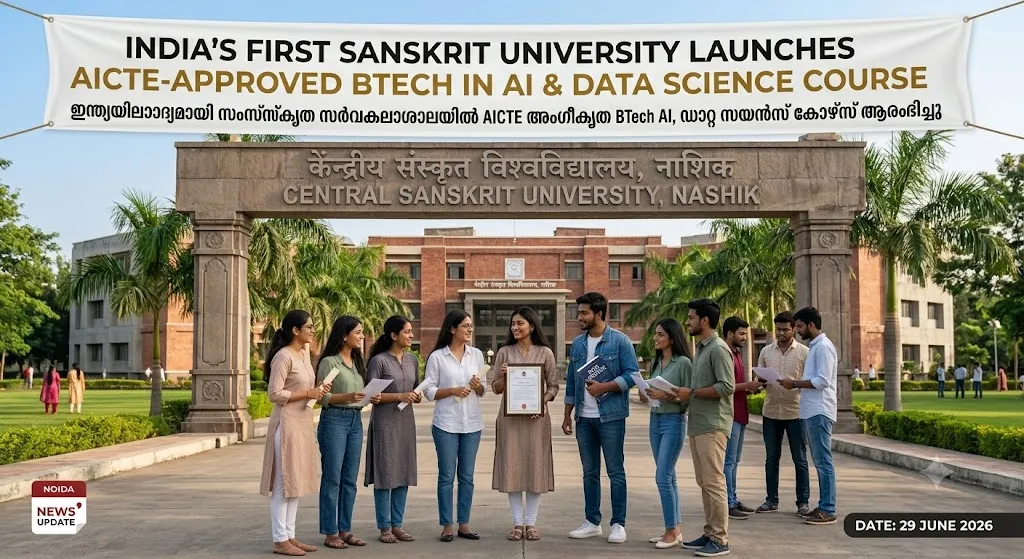
BTech in AI and Data Science : In an unprecedented academic milestone that bridges ancient linguistic genius with futuristic computing, the Central Sanskrit University (CSU) in New Delhi has officially launched a four-year BTech in AI and Data Science. This marks the first time in Indian history that a traditional Sanskrit institution is entering the technical engineering domain.
Fully approved by the All India Council for Technical Education (AICTE), this highly anticipated degree program will commence from the 2026–27 academic session at the university’s Nashik campus. By establishing this interdisciplinary gateway, the institution aligns itself with the core tenets of the National Education Policy (NEP) 2020, transforming a classical center of learning into a vibrant, multi-disciplinary technical hub.
The Visionary Objective Behind the Merger
The integration of Sanskrit with computer science is far from arbitrary. Modern researchers have long acknowledged that Paninian grammar—the structured, rule-based linguistic framework of Sanskrit—operates on logical structures highly akin to computer code, making it exceptionally compatible with natural language processing (NLP) and machine learning frameworks.
The launch of the BTech in AI and Data Science gained widespread national attention after Prime Minister Narendra Modi lauded the move during his Mann Ki Baat radio address. He emphasized that the initiative serves the dual purpose of equipping young minds with state-of-the-art tech skills while keeping them firmly connected to India’s profound intellectual heritage. The long-term goal is to leverage advanced computational engineering to decode, digitize, and translate millions of ancient Indian manuscripts on science, astronomy, mathematics, and metallurgy that currently lie unread or inaccessible in archival libraries.
Under the Hood: A Dual-Core Curriculum
Unlike standard computer science degrees, this specialized BTech in AI and Data Science provides a highly innovative, dual-layered learning trajectory. The curriculum is split symmetrically between core industrial engineering subjects and Indian Knowledge Systems (IKS).
1. Mainstream Technical Training
Students are trained thoroughly in the operational aspects of modern technology, covering industry-demand subjects such as:
-
Machine Learning & Deep Learning
-
Python Programming & Big Data Analytics
-
Cloud Computing & Neural Networks
-
Mathematical Statistics & Predictive Modeling
2. Computational Linguistics & Cultural Systems
Simultaneously, the program delves deeply into the analytical structure of classical systems, training students in fields like:
-
Paninian Grammar & Computational Linguistics
-
Natural Language Processing (NLP) & Conversational AI
-
Machine Translation & Conversational Systems
-
Optical Character Recognition (OCR) for historical scripts and manuscriptology
This multifaceted training ensures that graduates are not just ready for conventional IT jobs, but are uniquely equipped to construct original algorithms for localized low-resource Indian languages.
Admission Pathway and Program Structure
To maintain strict academic competitive standards, admissions into this innovative engineering program will be entirely merit-based.
For the inaugural batch, the university has announced a sanctioned intake of 66 seats, which includes 60 regular seats and six supernumerary allocations. Prospective candidates must have cleared their higher secondary (10+2) board examinations with physics, chemistry, and mathematics as core compulsory subjects. The final shortlisting process will heavily factor in scores obtained through national-level engineering entrance examinations or the Common University Entrance Test (CUET) 2026.
Once admitted, students will undergo standard technical evaluations spread across eight semesters, culminating in deep-tech capstone projects that merge algorithmic coding with language technologies.
Why This Program Redefines India’s AI Ecosystem
As global technological landscapes demand domain-specific AI models, the introduction of the BTech in AI and Data Science at a Sanskrit university could not have been timed better.
Currently, large language models (LLMs) heavily favor Western scripts due to a lack of clean, well-annotated non-Latin datasets. By preparing engineers who natively understand both code architecture and ancient phonetics, this program will create a talent pool capable of building production-level NLP pipelines tailored explicitly for Indian scripts. Furthermore, it creates exciting research vectors where students can apply modern computational analytics to traditional disciplines like Ayurveda, Yoga, Nyaya (logic), and Vastu, thereby verifying ancient sciences through contemporary digital evidence.
Looking Ahead: Enrollment Open
As enrollment portals officially open for the 2026–27 academic term, the Central Sanskrit University expects strong application volumes from both traditional science students looking for a unique niche, as well as students with a classical background who wish to pivot toward software development.
With sectors like healthcare, governance, defense, and digital humanities demanding specialized data analysts, this program establishes a unique milestone. It proves that India’s tech future does not require leaving its historical roots behind; rather, it uses the strength of the past to build the systems of tomorrow. Detailed prospectuses and registration forms can be accessed on the official varsity website at sanskrit.nic.in.
Also Read….