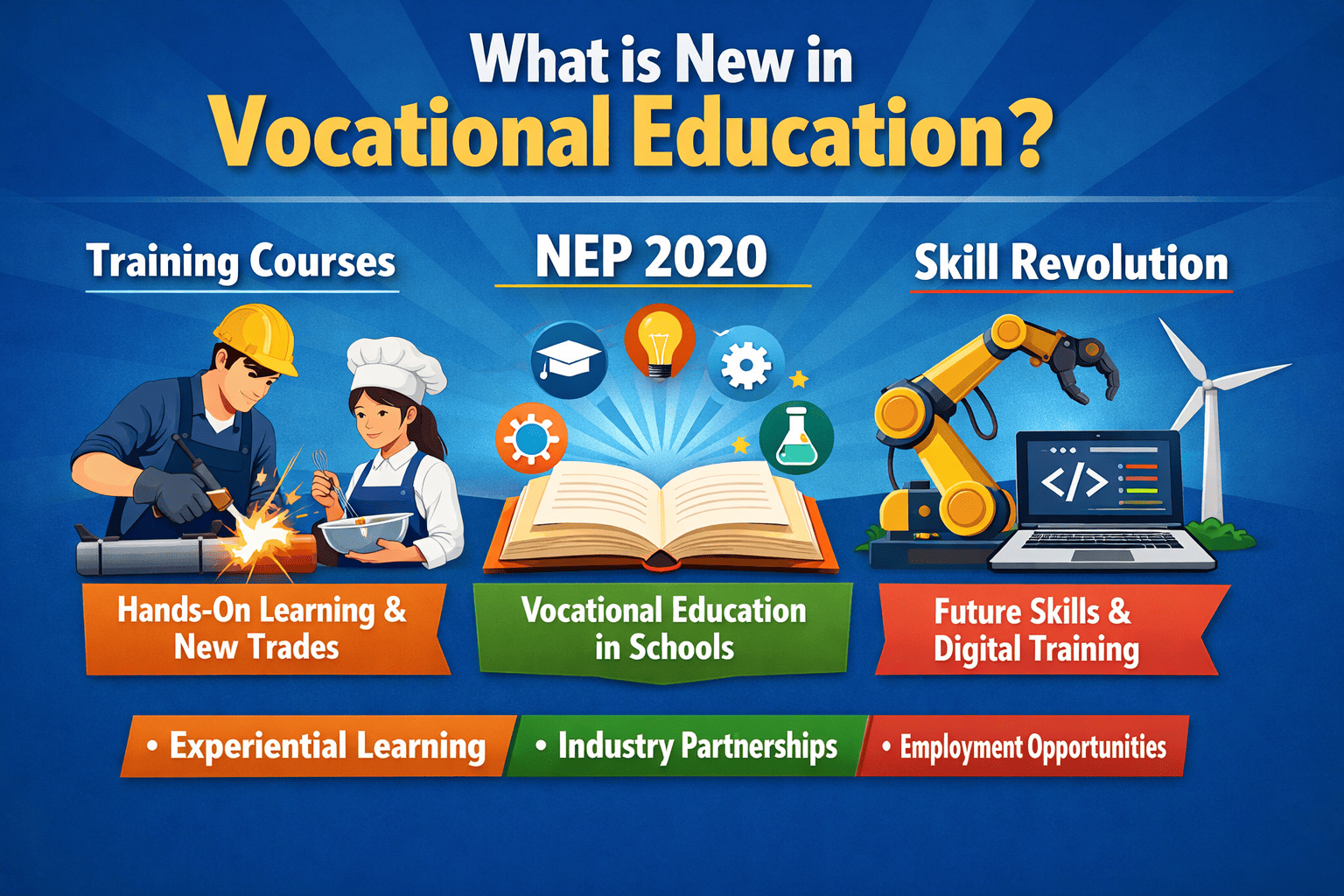
January 31, 2026 – Vocational education in India is witnessing a dramatic shift with new training courses, policy reforms, and industry partnerships that promise job-ready skills and entrepreneurial opportunities for millions of students.
IIT Bombay launched an 18-month e-Postgraduate Diploma in Integrated Circuits Design with fees at Rs 3.60 lakh, targeting semiconductor professionals. IGNOU introduced India’s first MSc in Community Development and Extension Management, blending social sciences with rural development skills. BHU developed 63 SWAYAM courses starting July 21 and August 18, covering engineering, Ayurveda, psychology, and commerce all free online.
IIT Madras began a four-year Sports Science BTech for 2025, combining analytics, physiology, and technology. Students can pursue specializations in quantum science, biomedical engineering (IIT Hyderabad), space engineering (IIT Indore), and ceramic engineering (IIT Varanasi). These programs accept JEE Advanced scores and require no biology background.
Vocational Education NEP 2020 Drives Major Changes
India’s National Education Policy 2020 mandates 50% students gain vocational exposure by 2025. Schools now integrate skill modules from Class 6, with subjects like coding, carpentry, and hospitality. Dual degree programs at IITs combine BTech with specialized masters, reducing time to expertise. Credit transfers allow students to switch between academic and vocational streams seamlessly.
Regional language instruction expands access. IIT Jodhpur offers BTech courses in Hindi and English, maintaining identical rigor across sections. Students switch languages mid-semester based on comfort. Karnataka’s SSLC exams now permit retakes in any subject to improve scores, erasing career setbacks from single-test failures.
Vocational Education Industry Partnerships Reshape Training
IIT Madras pledged Rs 5 crore over five years for 200 sports-tech startups, funding innovations in athlete monitoring and game analytics. ESPN uses IIT-developed sensors for tennis and badminton broadcasts. Zoho Corporation funds entrepreneurship programs, while BITS Pilani received $1 million to establish the KRITI Centre for rural innovation, blending technology with grassroots challenges.
Corporates now design curricula directly. Adobe, Bosch, ETH Zurich host interns from quantum science programs. Placement-driven courses guarantee teaching assistant roles, seed funding, and alumni networks for self-employment. Anti-plagiarism systems and continuous faculty development (Nepal UGC model) ensure quality.
Digital Platforms Democratize Access Vocational Education
SWAYAM hosts 100+ autonomous programs from central universities, IITs, and NITs. Courses run 4, 8, or 12 weeks, with exams starting October 2025. IGNOU’s Samarth Portal enables Rs 7,000/year MSc admissions with credit-based flexibility. DigiLocker now stores NEET, JEE scorecards, making verification instant.
Online counseling for JEECUP, JoSAA simplifies seat allotment. Kerala HSCAP added 64,000 contingency seats for Plus One admissions, with results on mobile dashboards. Aadhaar-based biometric authentication (UPSC pilot) curbs exam malpractice.
Skill-to-Employment Pathways
TNPSC Group 2 recruits 2,000+ posts via vocational qualifications. IBPS fills 4,545 clerk, 3,049 PO, and 1,402 specialist roles for PSU banks, accepting vocational diplomas. Telangana TET registers 100,000+ teachers annually, many from B.Ed-M.Ed dual streams.
Rajasthan BSTC offers 25,977 DElEd seats across 343 private colleges and 33 DIETs, with Rs 3,000 counseling fees. Karnataka’s third SSLC exam (August 2-9) lets students improve marks, aiding 78% pass-rate recovery. Every retry costs Rs 407–682, removing one-chance career limits.
Equity and Access Reforms
Vocational Education UGC guidelines (mirrored in Indian states) target lagging provinces via peer learning and resource sharing. Women, SC/ST, PwD candidates receive fee waivers in NEET PG, UPSC, and state exams. Mobile-first interfaces for DHSE Kerala, CISCE improvement exams ensure rural connectivity.
GER targets (25% by 2030) push state governments to fund polytechnics and skill hubs. Accreditation mandates (76+ institutions, Nepal UGC 2021) force quality benchmarks. India’s non-government sector growth (private ITIs, online universities) expands seats without budget strain.
Emerging Trends to Watch
Vocational Education Hybrid exams (CUET’s online + pen-paper mix) test scalability. Data analytics (IIT Madras NEET audit) detect malpractice via city-wise anomaly checks. Blockchain certificates prevent forgery. AI-powered doubt resolution in SWAYAM courses personalizes learning.
Startup ecosystems within campuses (KRITI, CESSA) convert projects into businesses. Mars Rover teams (IIT Mandi) secure institute funding, proving vocational learning transcends classrooms. Sports scholarships (IIT Madras admits athletes with CGPA 8.0+) value non-academic excellence.
Why Vocational Education Matters Now
With 20 lakh+ NEET aspirants, 10 lakh+ UPSC candidates, and 23 lakh+ CUET students annually, traditional paths overflow. Vocational courses offer faster employment (6-18 months), lower debt (Rs 7,000–3.6 lakh), and entrepreneurship via seed capital. Market-driven curricula (semiconductor chips, sports tech, rural development) match industry needs.
Student-centric reforms—credit transfers, language flexibility, improvement exams—reduce dropout fears. Anti-plagiarism tools and faculty upgrades maintain standards. India’s skilled workforce now competes globally, from ceramic engineers designing spacecraft materials to biomedical innovators building prosthetics.