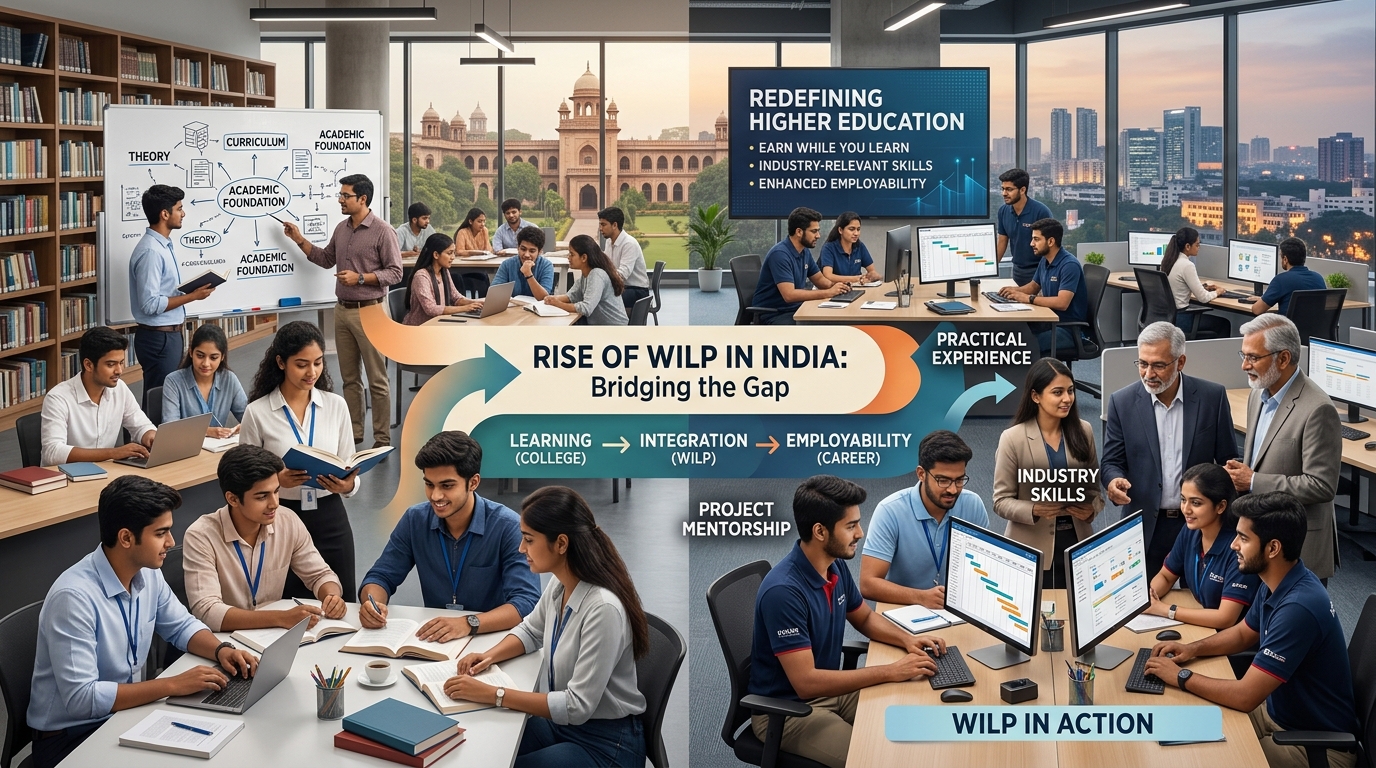
A silent transformation is unfolding across India’s higher education sector. From metro cities to emerging industrial hubs, a growing number of working professionals are moving away from traditional university models and embracing a more flexible, industry-linked path to learning.
The shift is being driven by Work-Integrated Learning Programmes, widely known as WILP.

Unlike conventional higher education routes that often require career breaks, fixed classroom schedules or passive online lectures, WILP programmes are designed around the realities of modern employment. Students continue working while pursuing their degrees, applying academic concepts directly within their professional environments.
Education experts say the model is gaining momentum among engineers, corporate employees, healthcare workers, banking professionals and mid-career managers seeking qualifications without stepping away from income or career growth.
What Makes WILP Different
At its core, WILP combines employment with structured academic learning. The model goes beyond standard distance or online education by integrating workplace experience into the curriculum itself.
Assignments are often linked to real-time industry problems. Projects may involve practical tasks within the student’s organisation. In many programmes, industry mentors work alongside academic faculty to guide learners through applied learning.
The approach is increasingly being viewed as a response to one of India’s long-standing education gaps — the disconnect between academic theory and workplace readiness.
“Traditional education and industry expectations have often moved separately,” said an education analyst based in Delhi. “WILP attempts to bridge that divide by ensuring learning happens alongside practical exposure.”
Why Professionals Are Opting for WILP
For many working adults, returning to full-time university education is financially and professionally difficult. Career interruptions can affect salary progression, family responsibilities and long-term stability.
At the same time, many professionals say conventional online degrees provide flexibility but lack industry relevance and engagement.
WILP programmes are emerging as a middle path — offering recognised academic qualifications while allowing learners to remain professionally active.
Industry observers note that the rise of automation, artificial intelligence and rapidly changing workplace requirements is also pushing professionals to upgrade qualifications faster than before.
“The demand for continuous upskilling is no longer limited to the technology sector,” said a senior HR consultant working with multiple corporate firms. “Employees across industries now recognise that career growth increasingly depends on learning while working.”
Alignment With India’s Education Reforms
The expansion of WILP also reflects broader policy changes under India’s National Education Policy (NEP) 2020, which encourages flexible learning pathways, multidisciplinary education and stronger collaboration between academia and industry.
As universities adapt to these reforms, work-integrated education models are receiving increased institutional attention.
Several universities have expanded programmes focused on career-oriented learning for employed students. Among them, MIT University Sikkim has emerged as one of the institutions emphasising practical and industry-linked education frameworks for working professionals.
Education experts say such programmes reflect a wider shift in how universities define employability and professional readiness.
Employers Are Taking Notice
Recruiters and HR professionals across sectors report that candidates who complete work-integrated programmes often demonstrate stronger practical understanding during interviews.
Employers say these graduates tend to communicate business problems more clearly and show greater confidence when applying theoretical concepts to real workplace situations.
“A professional who studies while actively working usually develops stronger contextual understanding,” said a recruitment lead at an infrastructure firm. “You can often see that difference immediately during problem-solving discussions.”
The Future of WILP in India
Analysts expect WILP enrolments to continue rising over the next several years as professionals seek qualifications that support both employment and career progression simultaneously.
For many learners, the appeal is no longer just convenience. Increasingly, WILP is being seen as a more industry-relevant model of higher education — one that prioritises practical capability alongside academic credentials.
As India’s workforce evolves, education experts believe the distinction between learning and working may continue to narrow, reshaping how universities prepare professionals for the future economy.