Bihar Engineering University: Over the last two decades, the technical education map of Bihar has shifted dramatically. What was once an ecosystem limited to historical state mainstays like the Muzaffarpur Institute of Technology (established in 1954) or the Bhagalpur College of Engineering (established in 1960) has evolved into a sprawling multi-district framework. Today, Bihar Engineering University (BEU), Patna, oversees a comprehensive network of 38 government engineering institutions—successfully realizing the state’s socio-political mandate of placing at least one technical campus in every single district.
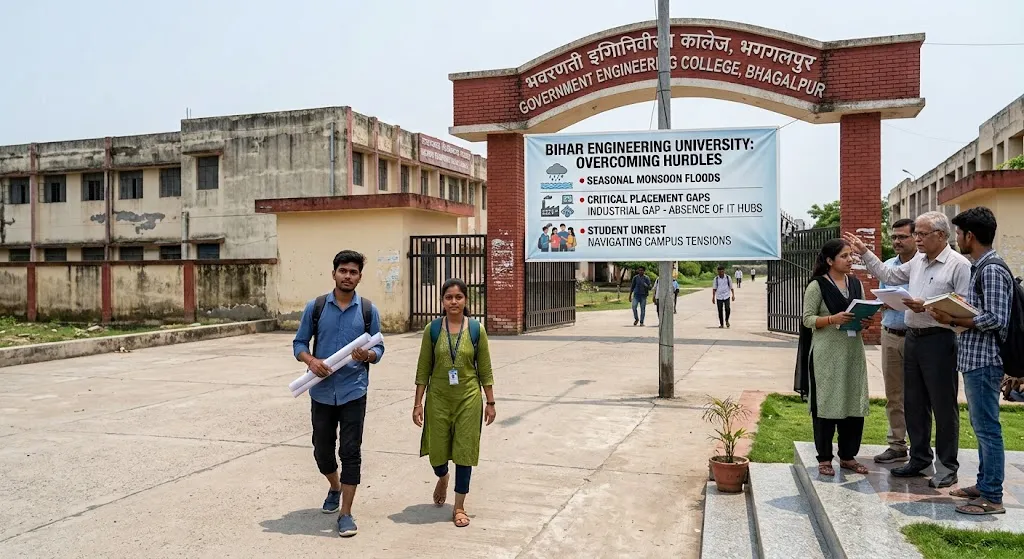
Yet, as this rapid institutional expansion cements its presence, the newly centralized varsity faces an intricate triad of roadblocks: disruptive seasonal floods, sporadic student unrest, and critical corporate placement gaps. Despite these deep-seated regional constraints, the university’s academic machinery continues to press forward, leveraging strong teaching fundamentals and looking toward future post-graduate integration.

Standing Tall Against Environmental Disruptions
Geographical location presents the primary annual obstacle for many satellite campuses under the BEU banner. Due to the state’s proximity to unstable Himalayan river systems, extensive areas face severe seasonal inundation. For instance, institutions in Bhagalpur, Darbhanga, and Sitamarhi frequently manage severe flooding during peak monsoon periods.
When regional rivers overflow, entire campus grounds can face heavy waterlogging, temporarily turning administrative corridors into isolated blocks. Despite these repetitive natural setbacks, the academic schedule rarely completely breaks down. The university regularly switches to hybrid operational models to protect student timelines. Faculty members adapt internal timelines to ensure that the foundational coursework for engineering cohorts remains completed before final university examinations commence.
Navigating Academic Rigor and Student Tensions
While environmental shifts dictate logistics, managing student engagement introduces a distinct sociological challenge. Historically, older regional colleges have dealt with occasional friction points and local disputes. Veteran professors note that the dynamics of handling modern batches require highly calibrated approaches compared to previous decades.
Beyond administrative diplomacy, newly introduced campuses face structural teething problems. While premier institutions possess expansive landscapes, newer sites like Government Engineering College (GEC) Sheikhpura deal with limited spaces and developing residential hostel units, complicating the task of maintaining long-term campus harmony.
The Core Battle: Overcoming the Placement Bottleneck
Among the hurdles facing Bihar Engineering University, establishing sustainable pathways into multinational corporate careers remains the most complex task. The central challenge does not stem from a deficiency in candidate talent, but from geographical and commercial isolation.
[Traditional System: Limited Colleges]
                 │
                 ▼ (Rapid Decentralization Policy)
[38 Government Engineering Colleges under BEU]
                 │
                 ▼ (Current Structural Hurdles)
┌───────────────────────────────┬───────────────────────────────┐
│       Geographic Woes         │        Industrial Gap         │
│  (Seasonal Monsoon Floods)    │  (Absence of Local IT Hubs)   │
└───────────────┬───────────────┘───────────────┬───────────────┘
                │                               │
                └───────────────┬───────────────┘
                                ▼
               [The Crucial Placement Bottleneck]
At Rashtrakavi Ramdhari Singh Dinkar College of Engineering in Begusarai, faculty members emphasize that infrastructural layouts are mostly complete and teaching vacancies are filled. The limiting factor is the relative absence of corporate recruitment drives. Because major technological hubs are concentrated in southern and western India, primary software and core industrial firms rarely send recruiters directly to remote Bihar districts. Consequently, engineering undergraduates face an uphill battle, often relying on self-guided off-campus applications or moving to larger metropolitan areas post-graduation to land stable software engineering roles.
The Path Ahead: Upgrades and Policy Support
Recognizing that relying purely on undergraduate programs limits industry collaboration, several colleges under BEU are actively working to upgrade their profiles. By introducing postgraduate research opportunities, campuses plan to build highly specialized talent hubs that are naturally more attractive to corporate R&D divisions.
For instance, Government Engineering College (GEC) Siwan has applied to launch targeted M.Tech programs, expecting formal approvals to kickstart advanced classes by the next academic cycle.
Ultimately, resolving the state’s engineering placement puzzle requires a combined push from institutional authorities and state industrial policymakers. Faculty members across the university system stress that direct government intervention is essential to forge structural tie-ups with manufacturing and IT sectors. By linking technical campuses with national apprentice portals and creating dedicated state-sponsored job fairs, Bihar Engineering University can ensure its massive decentralized footprint successfully translates into viable economic opportunities for its resilient student base.
For the latest update, check news.imtsinstitute.com