The official JEE Advanced 2027 syllabus and information brochure have not been released yet, but no major changes are expected from the pattern followed in 2025 and 2026, which was introduced after the last major syllabus revision in 2023. Candidates can therefore begin preparation using the current syllabus and topic-wise weightage trends, and adjust later once IIT Delhi or the organising IIT publishes the official brochure on jeeadv.ac.in.
JEE Advanced tests Physics, Chemistry, and Mathematics roughly equally, with each subject contributing close to a third of the total marks across both papers.

Important Mathematics Topics
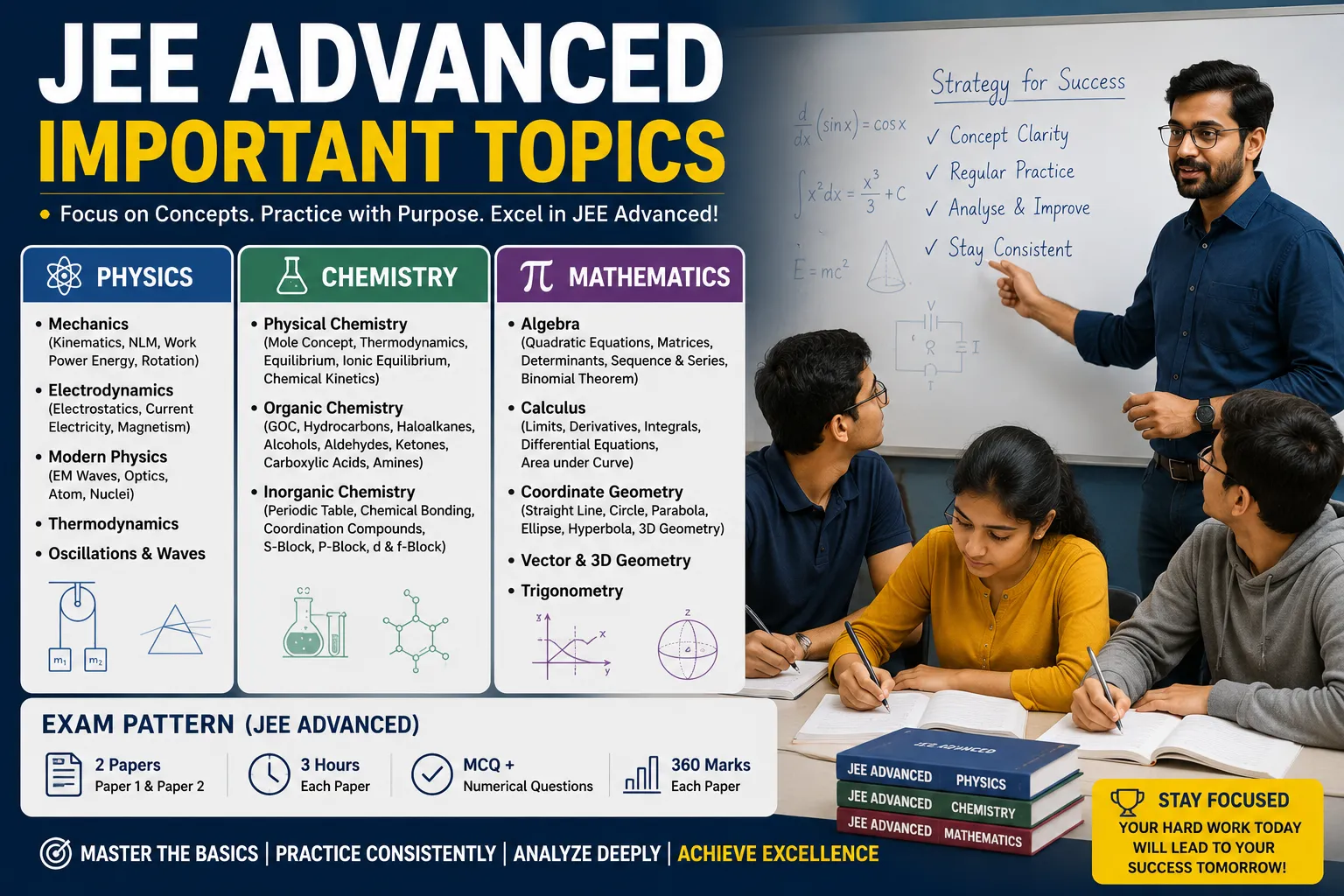
Calculus and Algebra together account for the largest share of the Mathematics section, historically contributing over half the marks in this subject. Within these, differential and integral calculus, along with matrices, complex numbers, and quadratic equations, are consistently high-scoring areas. Coordinate Geometry, covering straight lines, circles, and conic sections, is another high-weightage but often tricky topic that regularly combines with other concepts in a single question.
Vectors, 3D Geometry, and Probability round out the remaining significant portion, while Trigonometry, though lower in weightage, frequently appears embedded within Calculus and Coordinate Geometry problems.
Important Physics Topics
Mechanics and Electricity & Magnetism together make up close to 45% of the Physics section, making them the two subjects candidates cannot afford to under-prepare. Modern Physics, including the Photoelectric Effect, X-rays, de Broglie Hypothesis, and Bohr’s Model, along with Nuclear Physics topics like radioactivity and binding energy, also carry meaningful weightage.
Thermodynamics and the Kinetic Theory of Gases test conceptual clarity combined with numerical accuracy, while Wave Optics and Ray Optics continue to be reliably scoring areas across recent years’ papers.
Important Chemistry Topics
Chemistry in JEE Advanced is split across Physical, Organic, and Inorganic sections, and candidates need a balanced approach across all three rather than favouring one. Based on past-year trends, Organic Chemistry typically carries the highest weightage, with Alcohols, Aldehydes, Ketones, and Amines appearing frequently. Physical Chemistry demands strong numerical skills, particularly in Thermodynamics and Chemical Kinetics, while Inorganic Chemistry topics such as P-Block and S-Block elements and Coordination Compounds are high-yield areas that reward focused memorisation paired with conceptual understanding.
How to Prepare Using These Topics
Since the 2027 brochure isn’t out yet, candidates are advised to start with the current official syllabus, build a chapter-wise priority list based on the weightage trends above, and revisit it once the official document is released for any additions or deletions.
Regular practice with previous years’ papers remains one of the most reliable ways to internalise how these high-weightage topics are actually tested, since JEE Advanced questions often combine multiple concepts rather than testing them in isolation.