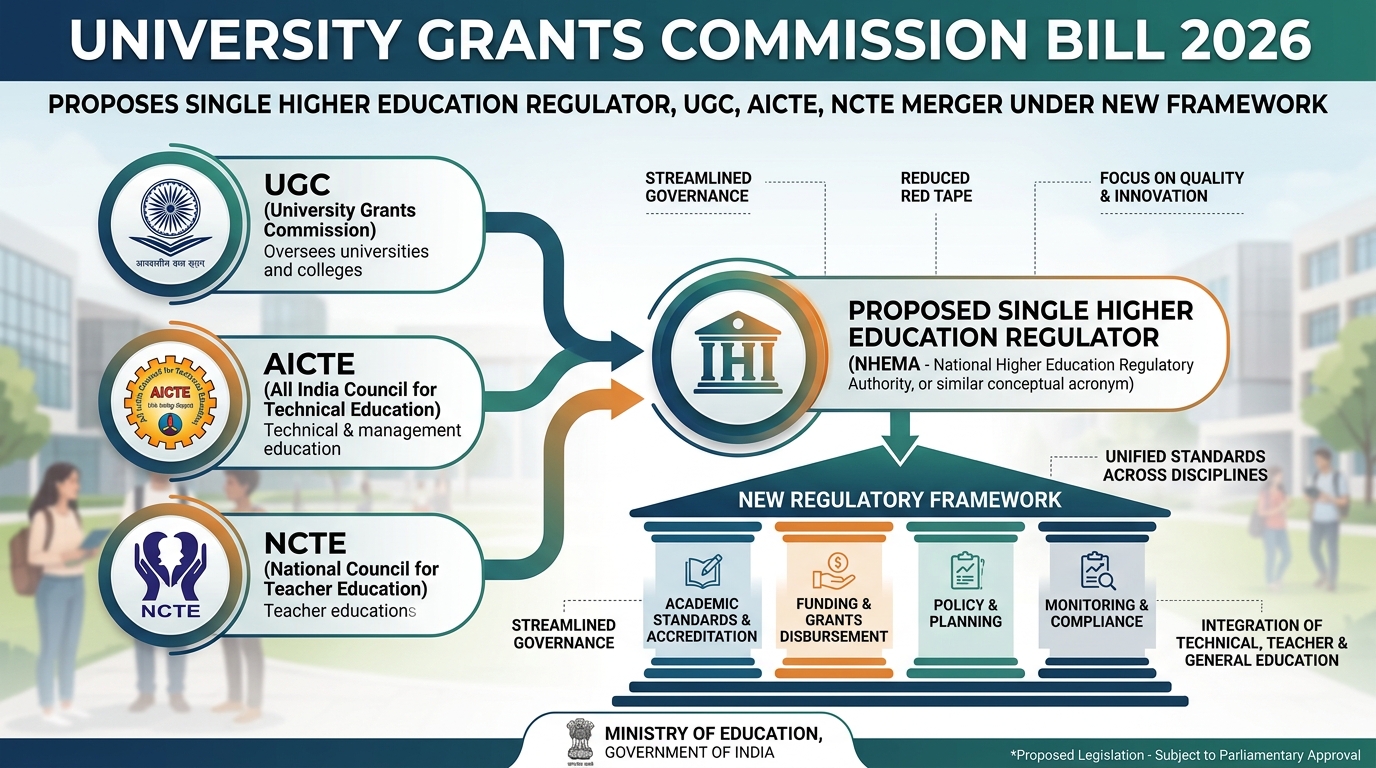
The proposed University Grants Commission Bill 2026 represents the most comprehensive higher education regulatory restructuring since India’s independence. The legislation seeks to dissolve three separate regulatory bodies — the University Grants Commission (UGC, established 1956), All India Council for Technical Education (AICTE), and National Council for Teacher Education (NCTE) — merging them into a unified national higher education commission with three specialized internal councils managing distinct regulatory functions.
The merger aligns with National Education Policy 2020 recommendations, which identified fragmented, overlapping regulatory structures as obstacles to institutional autonomy, quality assurance innovation, and international academic competitiveness. The proposed unified commission implements the separation of functions principle, ensuring funding roles, approval authorities, and quality oversight remain institutionally distinct, eliminating conflicts of interest inherent in the current model.

STRUCTURAL COMPONENTS OF PROPOSED REGULATION:
Internal Council for Standards: Establishes minimum quality benchmarks, academic standards, and curriculum frameworks Approvals Council: Processes institutional recognition, program accreditation, and regulatory compliance certifications Quality & Transparency Council: Conducts external audits, publishes performance metrics, and enforces institutional accountability
EQUITY AND NON-DISCRIMINATION FRAMEWORK:
The bill incorporates the UGC Promotion of Equity in Higher Education Institutions Regulations 2026, establishing mandatory Equal Opportunity Centres and time-bound complaint resolution mechanisms across all universities. This integration makes equity protection a foundational regulatory principle rather than supplementary institutional practice.
INTERNATIONALIZATION STRATEGY:
The bill positions internationalization as a strategic priority, facilitating cross-border academic collaboration, Indian university overseas presence, recognition of foreign qualifications, and adoption of international best practices. These provisions aim to enhance global competitiveness of Indian institutions, attract international research partnerships, and improve employer recognition of Indian degrees in global markets.
The bill was referred to a Joint Parliamentary Committee (JPC) for detailed examination, which delayed final passage beyond 2025. Parliamentary scheduling and JPC completion timelines suggest likely passage during 2026 parliamentary sessions. Once enacted, the government will issue detailed implementation regulations, institutional transition procedures, and timeline roadmaps for the regulatory consolidation process.
PROPOSED BILL IMPLICATIONS:
Unified Regulator Advantages: Consistent standards, reduced bureaucratic redundancy, improved institutional accountability University Autonomy Impact: Increased academic freedom balanced against strengthened quality oversight Student Protections: Enhanced through equity frameworks and transparent complaint procedures International Recognition: Improved through standardized accreditation and global collaboration provisions
INSTITUTIONAL ADAPTATION REQUIREMENTS:
Universities and colleges must prepare for regulatory transition procedures, re-accreditation processes, and updated compliance frameworks upon bill passage. Administrative leadership should review internal governance structures for alignment with emerging regulatory expectations, strengthen equity and quality mechanisms, and establish international partnership protocols to capitalize on internationalization provisions.