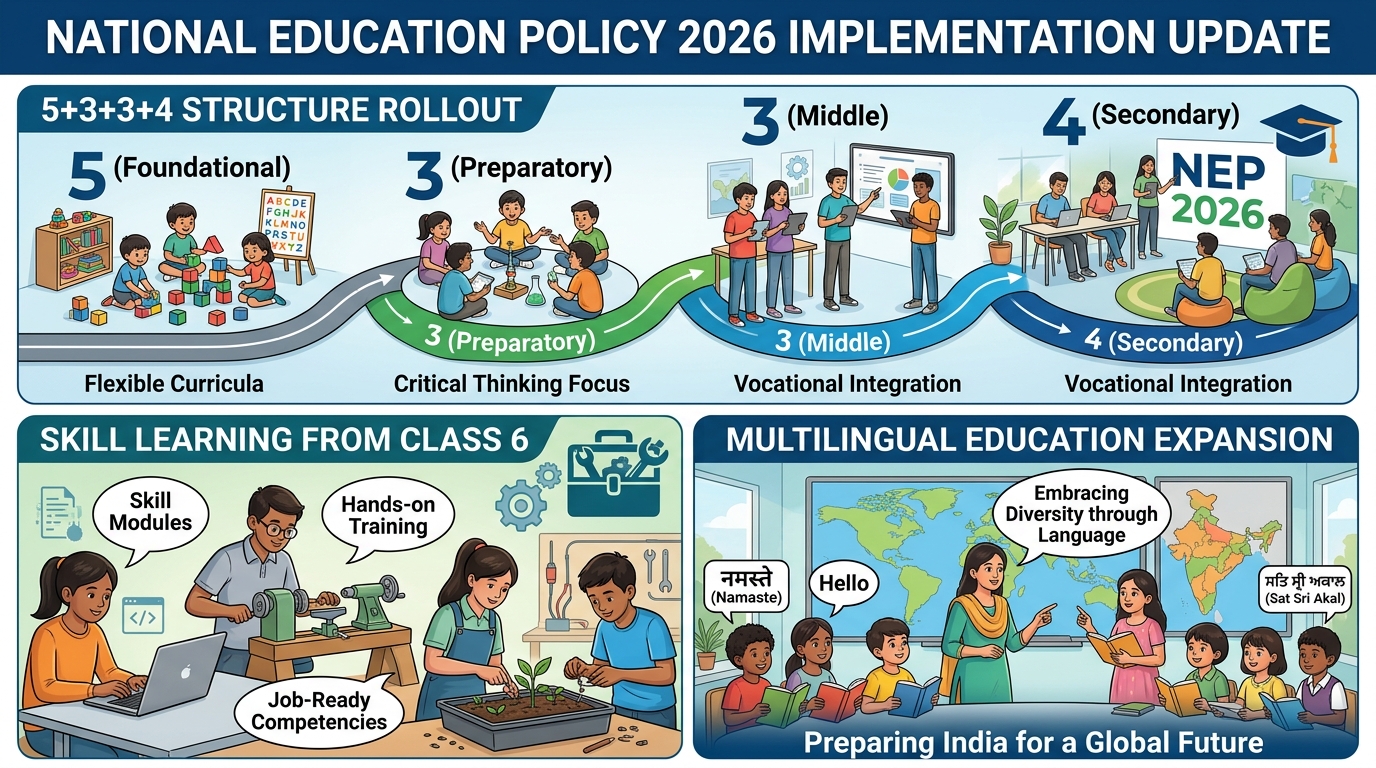
The National Education Policy 2020, now in active implementation during the 2025-26 academic session, is advancing key systemic transformations across India’s school education system. The 5+3+3+4 educational structure, replacing the traditional 10+2 model, divides school education into Foundational Stage (Classes 1-5), Preparatory Stage (Classes 6-8), Middle Stage (Classes 9-10), and Secondary Stage (Classes 11-12), enabling age-appropriate learning progressions and flexible transition opportunities.
The Ministry of Education’s official NEP implementation portal, updated on May 13, 2026, documents measurable progress in structural transformation, vocational integration, and multilingual implementation across participating schools and state education departments nationwide.

VOCATIONAL EDUCATION INTEGRATION:
Under NEP 2020 provisions, vocational and skill-based learning has been mandated in Classes 6 through 8, introducing students to practical trades, craft skills, and livelihood competencies during foundational academic years. This integration enables early career awareness, hands-on learning experience, and transition pathways to technical education or direct employment for students not pursuing traditional academic trajectories. Subject integration ensures life skills training (financial literacy, entrepreneurship, resource management) becomes foundational curriculum components rather than supplementary activities.
MULTILINGUAL EDUCATION FRAMEWORK:
The policy mandates mother tongue or regional language as medium of instruction through Class 5, with gradual introduction of English and Hindi as additional languages. This linguistically-inclusive approach improves conceptual understanding, reduces learning anxiety for rural students, and preserves linguistic diversity while enabling English proficiency through systematic exposure rather than premature language substitution. CBSE-affiliated schools and progressive state boards are implementing these transitions, though implementation quality varies across regions based on teacher training availability and resource allocation.
UNION BUDGET 2026-27 SUPPORT MECHANISMS:
The fiscal year 2026-27 budget has allocated specific provisions for digital learning infrastructure expansion, girls hostel establishment in all districts, university township development near industrial zones, and STEM teacher training initiatives. These infrastructure investments directly enable NEP implementation acceleration, particularly for rural schools, girls’ education, and STEM pathway expansion.
NEP 2026 IMPLEMENTATION METRICS:
Structural Model: 5+3+3+4 system replacing 10+2 Vocational Mandate: Classes 6-8 skill-based learning integration Language Policy: Mother tongue medium through Class 5 Teacher Development: NEP-aligned curriculum and pedagogy training Budget Support: Union Budget 2026-27 infrastructure allocations Implementation Timeline: Phased rollout across states through 2026-27
LEARNING OUTCOMES AND PEDAGOGICAL SHIFTS:
NEP implementation emphasizes critical thinking, conceptual clarity, and practical application over rote memorization and competitive examination focus. Schools are adopting inquiry-based learning, project-based assessment, and collaborative problem-solving methodologies aligned with 21st century skill requirements. Students experience reduced examination stress, greater learning autonomy, and improved retention of conceptual understanding through these pedagogical transformations.
Parents should expect evolving school evaluation methods, with reduced standardized testing frequency, increased project-based assessment, and holistic development reporting. Students gain greater flexibility in subject selection, multiple career pathway exposure, and skill-based learning recognition through official certificates and credentials.