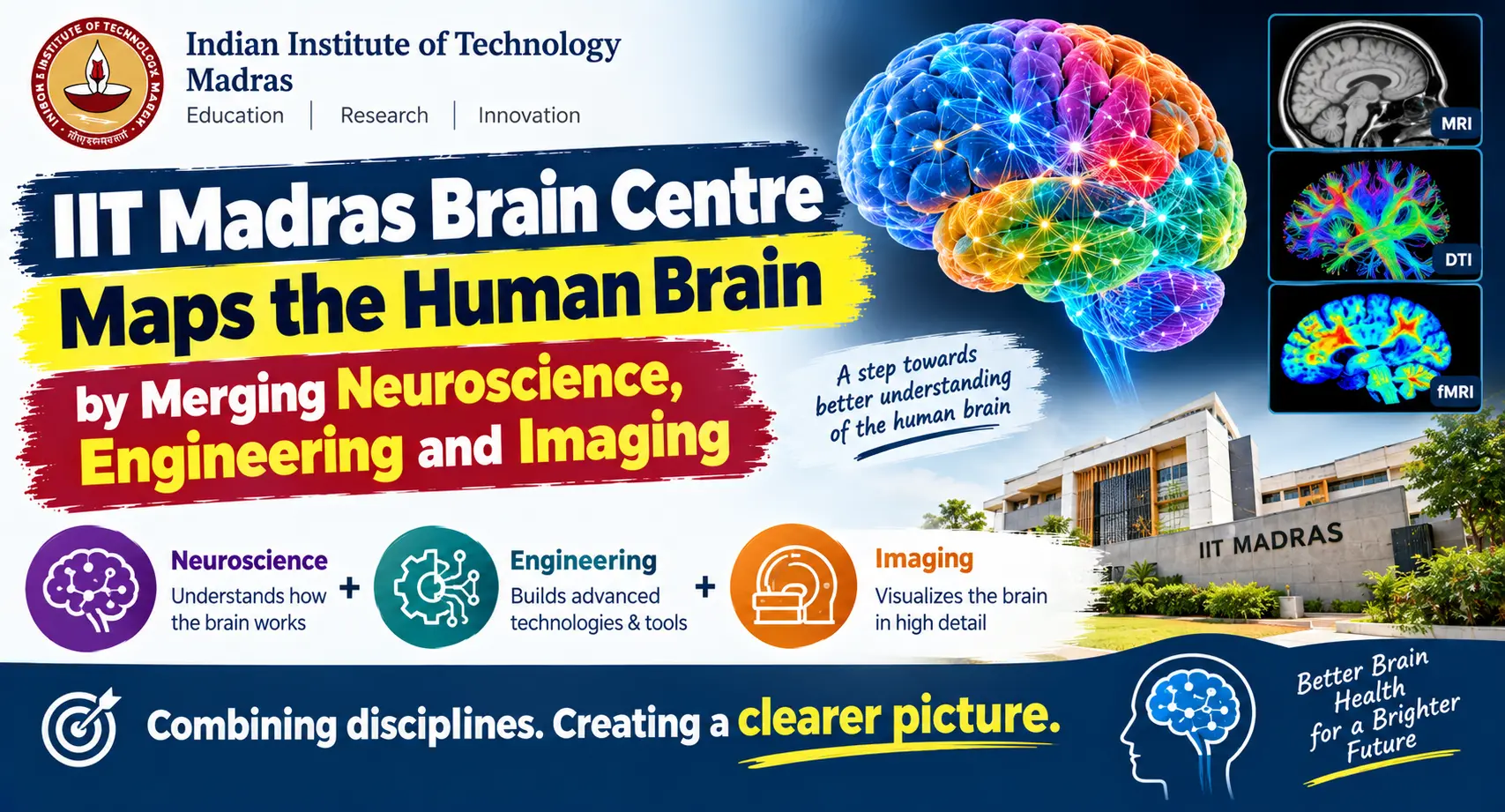
IIT Madras Brain Centre: The Indian Institute of Technology (IIT) Madras is mapping the human brain using a combination of neuroscience, engineering, and advanced imaging techniques. According to official information, the Sudha Gopalakrishnan Brain Centre (SGBC) has become one of the institute’s important research initiatives, aiming to “map the entire human brain, cell by cell, and share it with the world.”
From Five Members to Over 200 Researchers
Established in 2022, the centre has grown significantly — from just five members to more than 200 doctors, scientists, technicians, and engineers working together on this large-scale research effort.

The centre is headed by Professor Mohanasankar Sivaprakasam of the Department of Electrical Engineering at IIT Madras. He has led the process of converting human brains into very high-quality digital images, involving a detailed multi-step process: freezing the brain, slicing it into extremely thin pieces, staining them, and scanning them using large-scale equipment developed in collaboration with an Indian company.
What SGBC Has Achieved So Far?
In a post on X, IIT Madras shared key details about the centre’s progress:
“Led by Prof Mohanasankar Sivaprakasam from the Department of Electrical Engineering, IIT Madras, with Dr Richa Verma as Scientific Director, SGBC has developed indigenous technologies for high-resolution brain imaging and digitisation. Each digital brain can generate nearly 1.5 petabytes of data.”
The institute also highlighted the scale of the initiative: with 400+ donated brains and global collaborations, SGBC is working to build an open resource aimed at advancing understanding of the human brain and neurological diseases.
Global Collaborations
Professor Sivaprakasam has noted that this field is too complex for a single country to solve alone. As a result, the department has formed partnerships with several universities in the United States, including the University of South Carolina, Johns Hopkins University, a university in Washington, DC, and the University of California, San Francisco (UCSF).
Speaking to a Colombian website, Sivaprakasam said: “Today we have 30 collaborators worldwide, in seven or eight countries, on different continents. Most are visiting professors who come and stay for two or three months. This continues to grow, and the next stage is for students to also come and stay for longer periods.”
The Scientific Goal Behind the Project
Dr Richa Verma, Scientific Director of the centre, explained the core motivation behind the initiative: understanding how the human brain is organised. She noted that much of current neuroscience knowledge comes from studies using monkey brains, but many treatments that work in those disease models have not translated successfully to humans — a gap SGBC’s human-brain-focused research aims to help close.
According to Dr Verma, the centre specifically studies how the brain changes structurally when affected by diseases such as strokes.
Studying Multiple Neurological Diseases
IIT Madras Director V Kamakoti has pointed out that the centre’s research extends beyond strokes, also covering brains affected by diseases such as rabies, dementia, and Alzheimer’s, in order to understand how these conditions alter brain structure over time.
Why This Matters?
This research initiative positions IIT Madras at the centre of a globally significant neuroscience effort, combining Indigenous technological development with international scientific collaboration. By building an open digital brain resource, SGBC’s work could potentially benefit researchers worldwide studying neurological diseases, rather than remaining confined to a single institution or country.
Given that each digitised brain generates close to 1.5 petabytes of data, the scale of this undertaking also reflects significant advances in imaging technology and data infrastructure within India’s research ecosystem — an area that has historically been dominated by international institutions and technology providers.
Key Highlights
| Particular | Details |
|---|---|
| Centre | Sudha Gopalakrishnan Brain Centre (SGBC), IIT Madras |
| Established | 2022 |
| Team size | 200+ (from initial 5) |
| Head | Prof Mohanasankar Sivaprakasam |
| Scientific Director | Dr Richa Verma |
| Donated brains | 400+ |
| Data per digital brain | ~1.5 petabytes |
| Global collaborators | 30, across 7-8 countries |
| Key partner universities | South Carolina, Johns Hopkins, UCSF, and others |
| Diseases studied | Strokes, rabies, dementia, Alzheimer’s |