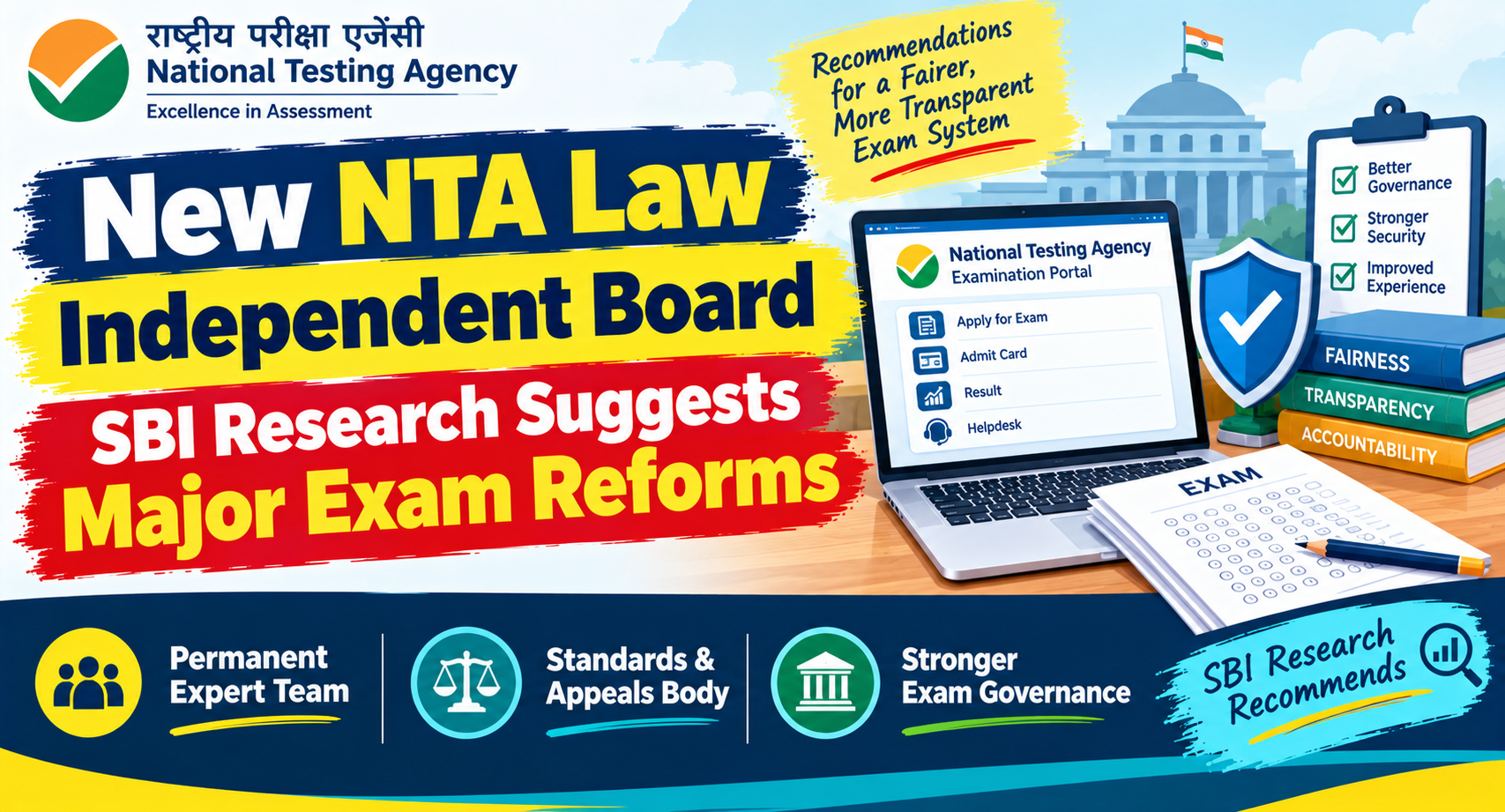
SBI Research NTA reforms: Research has recommended a separate law for the National Testing Agency (NTA), backed by an independent governing board, a permanent professional workforce, and a dedicated mechanism for examination standards and candidate appeals. These proposals form part of a broader reform agenda aimed at India’s examination and higher education systems.
SBI Research Calls for a Separate NTA Law
According to the report, SBI Research has proposed replacing the NTA’s existing status as a society under the Societies Registration Act with a statutory body established through an Act of Parliament.

The NTA was established in 2018 and had conducted more than 240 examinations involving over 5.4 crore candidates by July 2024. Given this scale of operations, SBI Research argues the agency needs a clearly defined legal mandate covering its responsibilities, governance, examination operations, and accountability.
Importantly, this proposed law would be separate from the existing Public Examinations (Prevention of Unfair Means) Act, 2024, which currently focuses specifically on preventing malpractice in public examinations.
Independent Board Proposed for NTA
The report recommends creating an NTA Board made up of independent experts from fields including assessment, technology, examination security, logistics, and accessibility.
This Board would:
- Provide oversight of the agency
- Approve examination readiness
- Oversee vendors involved in examination-related activities
Under this proposed structure, the Director General or CEO would continue to manage the NTA’s day-to-day functioning, but would now operate under the Board, creating a clearer separation between institutional oversight and routine administration.
Building Permanent In-House Expertise
SBI Research has also called for a permanent professional team within the NTA, with specialised expertise in assessment, technology, security, examination operations, and candidate support.
The report proposes bringing critical examination functions under the agency’s direct control, reducing excessive dependence on outsourced services and infrastructure — ensuring core capabilities required to design, secure, and administer exams remain in-house rather than vendor-dependent.
Independent Body for Standards and Appeals
Another key proposal is the creation of an independent Standards and Appeals Body, responsible for:
- Auditing high-risk examination processes
- Handling final administrative appeals in serious cases
The report also calls for stronger controls over question-paper custody, independent reviews of examination processes, and more effective grievance mechanisms for candidates.
Lessons from China’s Gaokao
SBI Research has suggested India could draw lessons from China’s Gaokao, one of the world’s largest examination systems, particularly in areas like logistics, implementation, and managing examinations at scale.
Broader Constitutional and Policy Recommendations
The report goes beyond examination reform, proposing that India examine whether Article 21 of the Constitution could be amended to recognise a right to free and fair educational opportunity — one that would protect students from fraud, discrimination, and unreasonable barriers to education. It also suggests that reforms to exams conducted by state public service commissions should be part of the wider reform agenda.
Key Data Points from the Report
| Particular | Details |
|---|---|
| NTA established | 2018 |
| Exams conducted (by July 2024) | 240+ |
| Candidates covered | 5.4 crore+ |
| Universities/colleges/institutions (FY24) | 64,756 |
| Student enrolment | 4.5 crore+ |
| Total teachers | ~17.32 lakh |
| Vacant teaching posts (centrally funded) | ~34% |
| Higher education spending share | ~1% (vs 1.6% in FY18) |
| Proposed spending share | 1.5% |
| Vocational training participation (15-29 age, 2025) | 30.7% (up from 7.1% in 2018) |
Why This Matters?
With India’s higher education system having expanded significantly — crossing 64,000+ institutions and 4.5 crore enrolments — SBI Research’s recommendations highlight persistent structural gaps: underfunded higher education, high teaching vacancy rates, and an examination system still operating without a dedicated statutory framework despite its massive scale. Coming amid continued scrutiny over exam irregularities in recent years, these proposals could shape future policy discussions around how India’s examination infrastructure is governed, funded, and made more accountable to the millions of candidates who depend on it annually.