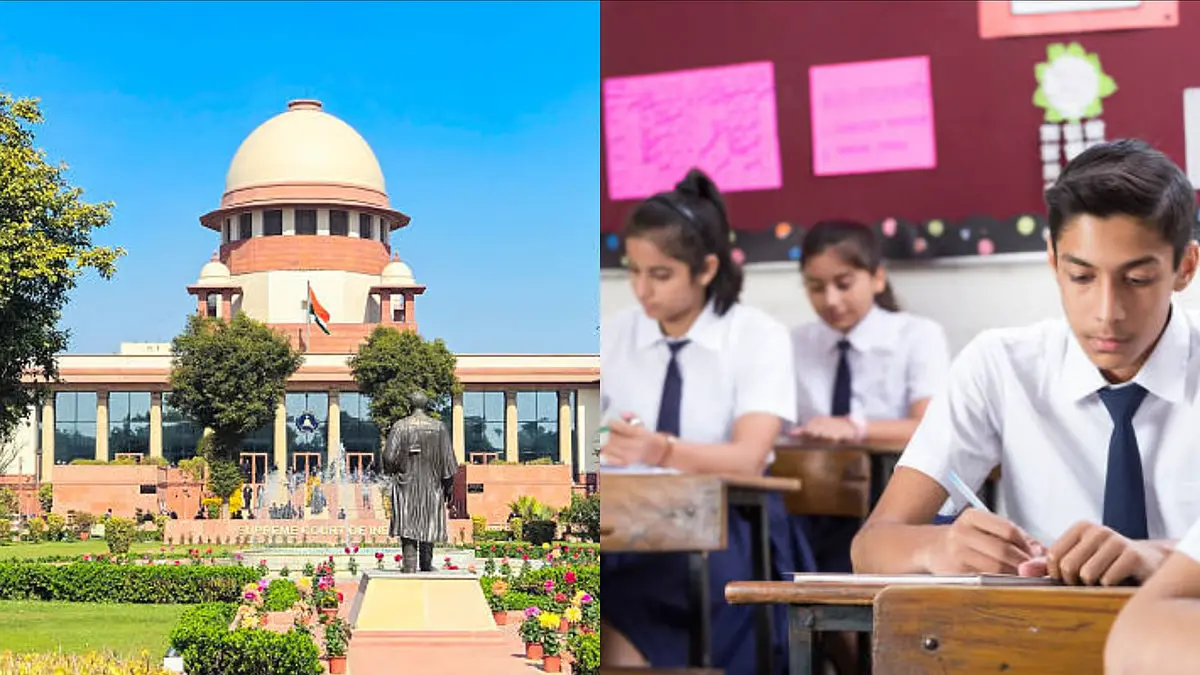
CBSE three-language policy Supreme Court: The Supreme Court on Wednesday asked the Central Board of Secondary Education (CBSE) to consider exempting Class 6 students from its three-language policy for the current academic year, even as it deferred the main hearing on a batch of pleas challenging the policy to September 17.
A three-judge bench led by Chief Justice of India (CJI) Surya Kant, also comprising Justices Joymalya Bagchi and V Mohana, asked the board to explore the possibility of accommodating Class 6 students in the ongoing session. The bench told Solicitor General (SG) Tushar Mehta: “Consider Class 6 for this year… If they can be given some accommodation.”

Why the Hearing Was Deferred?
SG Mehta requested the court to defer the hearing since Additional Solicitor General Aishwarya Bhati was unavailable. He assured the bench that officials concerned would examine the court’s suggestion, stating: “All of us would sit together and revert to your lordship.”
However, senior counsel representing one of the petitioners urged that the matter not be delayed further, pointing out that students have upcoming examinations, and repeated adjournments were causing anxiety among parents.
Background: What the Policy Requires
The Supreme Court is hearing a batch of pleas challenging CBSE’s policy mandating the study of three languages — including two native Indian languages — for Class 9 students, effective from July 1. As per a CBSE circular dated May 15, students opting for a foreign language can do so only after studying two native Indian languages, either as a third language or as an additional fourth language.
This policy is part of CBSE’s broader effort to align its scheme of studies with the National Education Policy (NEP) 2020 and the National Curriculum Framework for School Education (NCF-SE), 2023.
Court’s Earlier Observations
This is not the first time the court has flagged concerns about the policy’s implementation. On August 20, the Supreme Court had stressed the need to resolve issues arising from the policy, observing that children should not come under any kind of pressure. The bench clarified that it found nothing inherently wrong with the policy itself, but noted concerns about the manner of its introduction.
At that hearing, the court had also pointed out the need to consider how to build adequate human resource infrastructure for the language options being offered, and had suggested: “If you have chosen Class 6 as the starting point, you may consider giving a reprieve to Class 6 students of this year. You can introduce it from next year.”
Jurisdiction Question Raised by Petitioners
Senior counsel for one of the petitioners has also argued that CBSE lacks jurisdiction or authority to frame the curriculum for Classes 6 to 8, contending that this responsibility lies with the NCERT instead. This jurisdictional question remains a live issue as the case proceeds.
Case Background
The Supreme Court had first agreed to examine a plea challenging the policy on May 27, issuing notices to the Centre, CBSE, and NCERT, seeking their responses on the matter.
What Happens Next?
With the matter now deferred to September 17, CBSE and the concerned government officials are expected to deliberate on the court’s suggestion regarding Class 6 students before the next hearing. Until then, uncertainty continues for students, parents, and schools regarding how the policy will apply to the current academic year, particularly for the Class 6 batch that was expected to be the starting point for implementation.
Key Highlights
| Particular | Details |
|---|---|
| Court | Supreme Court of India |
| Bench | CJI Surya Kant, Justices Joymalya Bagchi and V Mohana |
| Suggestion | Exempt current Class 6 batch from three-language policy |
| Next hearing date | September 17, 2026 |
| Policy applies to | Class 9 students (from July 1) |
| Policy origin | CBSE circular dated May 15 |
| Aligned with | NEP 2020, NCF-SE 2023 |
| Key petitioner argument | CBSE lacks jurisdiction over Classes 6-8 curriculum (NCERT’s domain) |