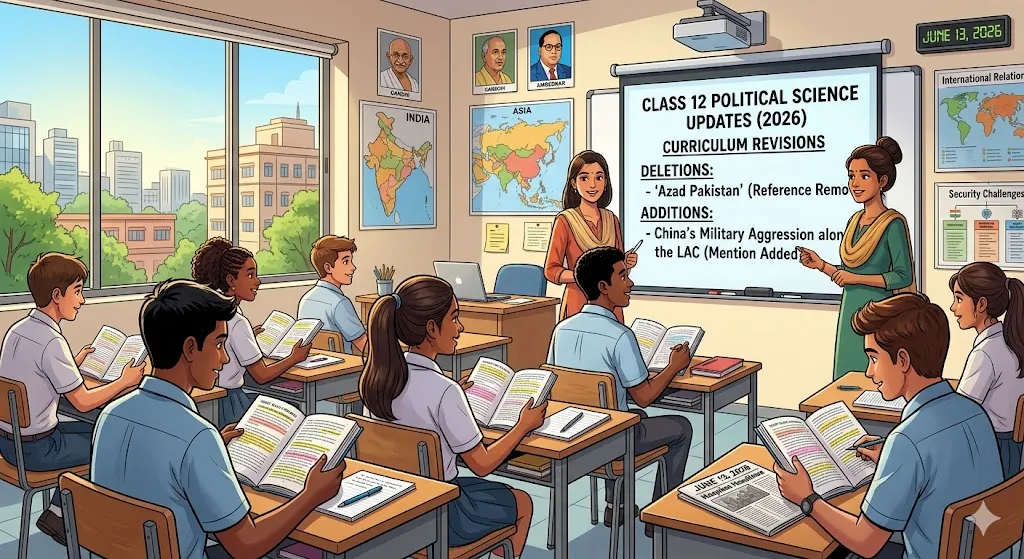
The National Council of Educational Research and Training (NCERT) has introduced fresh revisions to its Class 12 Political Science textbook, altering key references related to Jammu and Kashmir and India’s border situation with China. The National Council of Educational Research and Training on Monday tweaked the reference to ‘Azad Pakistan’ and added ‘Chinese aggression’ in political science textbooks for Class 12 students. These changes have once again brought NCERT’s curriculum revisions into the spotlight, continuing a pattern of updates the council has made to align textbook content with the government’s current positions on key geopolitical issues.
‘Azad Pakistan’ Replaced With ‘POJK’

One of the most significant edits appears in the textbook “Politics in India Since Independence.” The term “Azad Pakistan” has been replaced with “Pakistan-occupied Jammu and Kashmir.” The original text on page 119 read, “India claims that this area is under illegal occupation. Pakistan describes this area as ‘Azad Pakistan’.” The updated version now says, “However, it is the Indian territory which is under illegal occupation of Pakistan called Pakistan-occupied Jammu and Kashmir (POJK)”.
NCERT has clarified the reasoning behind this change. The Class 12 Political Science textbook has stated that these changes align with the latest position of the Government of India regarding Jammu and Kashmir. As per NCERT, this change was made in line with the latest position of the Government of India vis-a-vis Jammu and Kashmir.
Reference to Article 370 Abrogation Added
Alongside the Kashmir-related change, the Class 12 Political Science textbook now explicitly mentions a major constitutional development. The updated textbooks explicitly mention the abrogation of Article 370, which granted special status to Jammu and Kashmir, in August 2019. A sentence has been added to the section on special provisions for certain states, stating that “Article 370, which contains special provisions for J&K, was abrogated in August 2019”.
The previous text on the subject had been more general in nature. Previously, the textbook read: “While most of the states have equal powers, there are special provisions for some states like J&K and the states in the North-East.” The changed version now includes additional context about the constitutional change that followed.
‘Chinese Aggression’ Replaces Reference to ‘Military Conflict’ on India-China Border
The second major revision concerns how the Class 12 Political Science textbook describes India’s relationship with China. This change appears in the “Contemporary World Politics” textbook. In Chapter 2 of “Contemporary World Politics,” under the section titled India-China relations, a sentence was changed. Previously, on page 25, it stated, “However, military conflict over a border dispute between the two countries marred that hope.” This has been revised to “However, Chinese aggression on the Indian border has marred that hope”.
This shift in language reflects a noticeably more direct characterization of the border situation. The previous sentence, which referred to a “military conflict over a border dispute,” has been replaced with a more assertive phrase, “Chinese aggression on the Indian border.” This alteration reflects the escalating tensions and recent clashes between the two countries.
Part of a Broader Pattern of Curriculum Changes
This latest round of edits is not an isolated instance but part of a continuing series of revisions to the Class 12 Political Science textbook curriculum. These revisions are part of a broader series of modifications to the NCERT curriculum in recent years. The changes come after the educational organisation changed references to the Gujarat riots and the Ayodhya dispute in earlier curriculum updates.
Class 12 Political Science textbook has previously faced criticism over similar changes, including the removal of references to prominent historical figures. As part of its “syllabus rationalisation” exercise, the NCERT, citing “overlapping” and “irrelevant” content as reasons, had earlier dropped certain texts from the course, including sections on the Gujarat riots, Mughal courts, the Emergency, the Cold War, and the Naxalite movement, among others, from its textbooks.
What This Means for Class 12 Students
With these revisions now part of the official Class 12 Political Science textbook curriculum, students preparing for board exams and competitive examinations should be aware of the updated terminology and framing, particularly around topics related to Jammu and Kashmir, Article 370, and India-China relations, as these may be reflected in textbook-based questions and classroom discussions going forward.
Key Takeaway: Class 12 Political Science textbook revisions replace “Azad Pakistan” with “Pakistan-occupied Jammu and Kashmir (POJK),” add a reference to the abrogation of Article 370, and reframe the India-China border description from “military conflict” to “Chinese aggression,” continuing a broader trend of curriculum updates aligned with the government’s current positions.