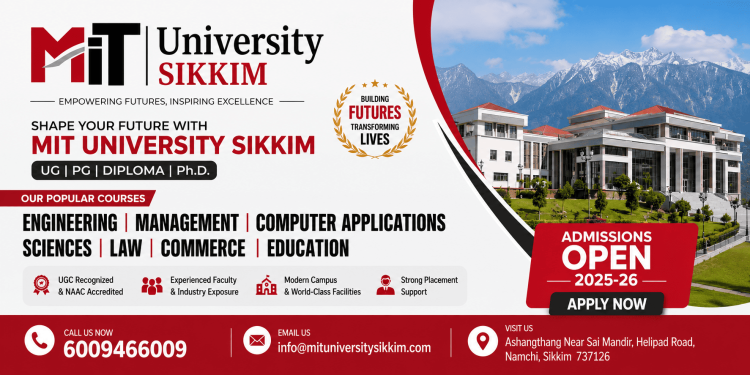
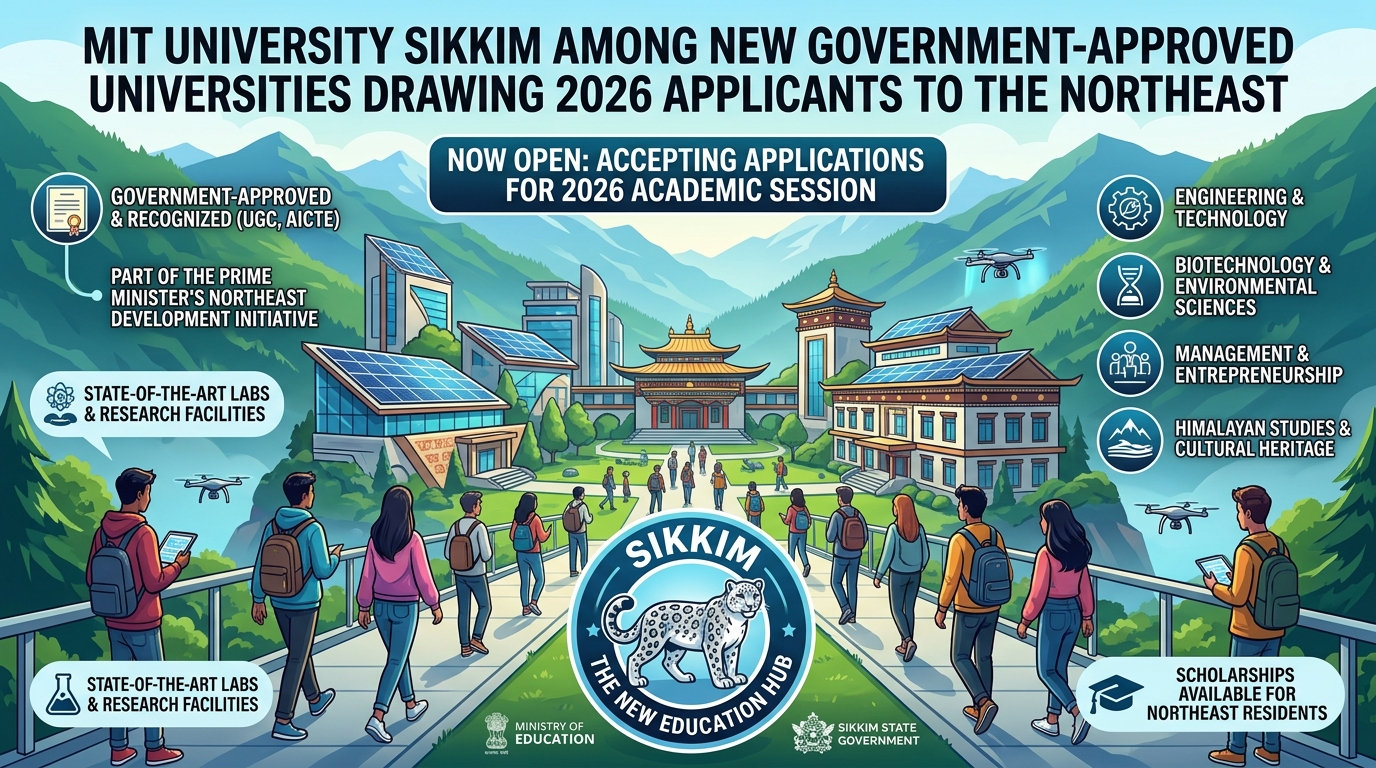
A new generation of universities is changing where Indian students choose to study, and Sikkim has quietly become one of the more interesting destinations on that map. At the centre of the shift is MIT University Sikkim, a government-approved institution that has opened admissions for 2026 and is positioning itself as a modern, industry-focused alternative to crowded metro campuses.
For years, students from the Northeast and beyond travelled to Delhi, Mumbai, Bengaluru or Pune for quality higher education. MIT University Sikkim was set up with the stated aim of changing that pattern. The university was established by the Government of Sikkim under Sikkim State Act No. 11 of 2024, giving it formal legal standing and the authority to award UGC-recognised degrees that are valid nationwide for higher studies, government jobs and private-sector careers.
Located in Melli in the Namchi district of South Sikkim, the university is promoted by the Institute of Management and Technical Studies Foundation, commonly known as the IMTS Foundation. It describes itself as a private university operating with full state-government approval.
What sets the institution apart in its own positioning is its emphasis on industry-integrated learning. Unlike traditional degree programmes where internships are optional, MIT University Sikkim has built mandatory industrial training into its curriculum. According to the university, students are expected to complete several months of hands-on work as a core graduation requirement, rather than treating it as an add-on. The aim, it says, is for graduates to leave with a real work portfolio and professional exposure before they finish their degree.
The curriculum is designed in line with the National Education Policy 2020, with a credit-based semester structure. The university offers a wide range of programmes across multiple faculties, spanning engineering, management, commerce, arts, design, life sciences, law and agriculture, at undergraduate, postgraduate and doctoral levels.
The Himalayan location is part of the appeal the university leans into. A campus set in Sikkim offers a calmer, cleaner environment than most large metro cities, and the state is widely regarded as one of India’s safest and most scenic. For students and parents weighing quality of life alongside academics, that combination is increasingly part of the decision.
Registration for undergraduate programmes for the 2026 academic session is already open. Prospective students are advised to check eligibility, course structure and fee details directly with the university before applying, as specifics vary by programme.
The broader trend is real. Across India, newer universities are competing less on legacy and more on how closely their teaching connects to actual employment. Work-integrated and industry-aligned models have gained ground because employers increasingly value practical experience alongside a degree. MIT University Sikkim is one of the institutions trying to build its identity around exactly that idea, and 2026 will be its early test as a founding cohort takes shape.
For now, the university represents something that would have seemed unlikely a decade ago: a serious, government-backed higher education option rising in the eastern Himalayas, asking students to look north instead of automatically heading to the metros.