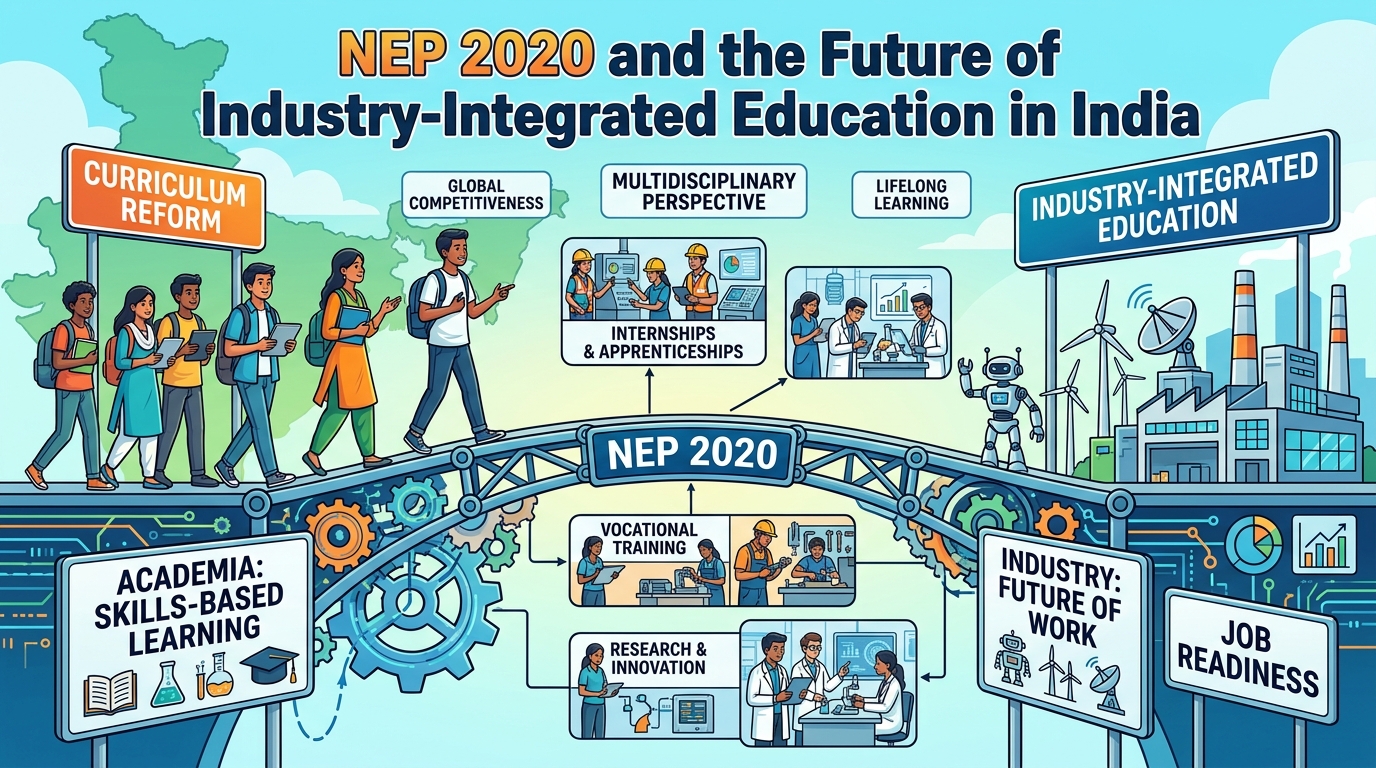
When India’s National Education Policy 2020 was unveiled, it was described as the most comprehensive overhaul of the country’s education framework in more than three decades. Four years into its implementation, one of its most consequential directions is becoming increasingly visible: the formal push toward industryintegrated, flexible, and practically oriented higher education.
For students, professionals, and universities alike, this shift carries significant implications.

What NEP 2020 Actually Says About Industry Integration
NEP 2020 explicitly promotes internships, vocational training, multidisciplinary learning, and stronger linkages between universities and industry. The policy encourages institutions to design curricula that reflect realworld professional requirements rather than purely theoretical frameworks inherited from decades past.
It also supports flexible entry and exit options, credit transfer mechanisms, and multiple learning pathways — all of which align closely with the WILP model that is currently gaining prominence across India’s higher education sector.
Policy observers note that NEP 2020 essentially provides the regulatory architecture needed for workintegrated learning to scale nationally.
The Gap Between Policy and Implementation
Despite the clarity of NEP 2020’s intent, implementation has been uneven. Many universities continue to operate traditional lectureexamination models with minimal industry engagement. Internship requirements remain inconsistently enforced. Industry mentorship within academic programmes is the exception rather than the rule at most institutions.
This gap between policy vision and institutional practice has created space for newer, more agile universities to distinguish themselves by actually building what NEP 2020 envisions.
Universities Ahead of the Curve
A small but growing number of universities have responded to NEP 2020 not with surfacelevel compliance but with genuine structural change. These institutions are redesigning degree programmes around applied learning, embedding industry collaboration into their academic calendars, and measuring success by graduate employment outcomes rather than examination pass rates alone.
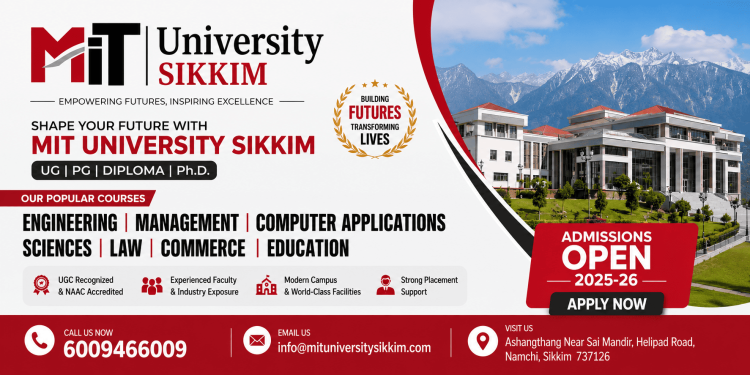
MIT University Sikkim represents one such institution — a university that has aligned its educational philosophy with the practical, industryaware direction that NEP 2020 promotes. By offering flexible, careerfocused programmes designed for working professionals, it reflects the kind of higher education model the policy was designed to encourage.
Why This Matters for Students Choosing Universities Today
For a student selecting a university in 2026, NEP 2020 alignment is more than a regulatory checkbox. It signals whether an institution is genuinely preparing graduates for the modern workforce or simply issuing credentials within a modernised bureaucratic framework.
Universities that have internalised NEP 2020’s industryintegration mandate will increasingly produce graduates who are employable, adaptive, and capable of contributing immediately in professional settings. Those that have not will continue producing graduates who face structural disadvantages in a hiring market that now demands demonstrated practical capability.
The Regulatory Direction is Clear
Education experts believe the UGC and AICTE will continue strengthening guidelines around industry integration, internship mandates, and practical learning assessments over the next three to five years. Universities that are not already building these capabilities face the risk of falling behind both regulatorily and reputationally.
For students, the message is actionable: choose institutions that have already made the transition — not those still planning to.