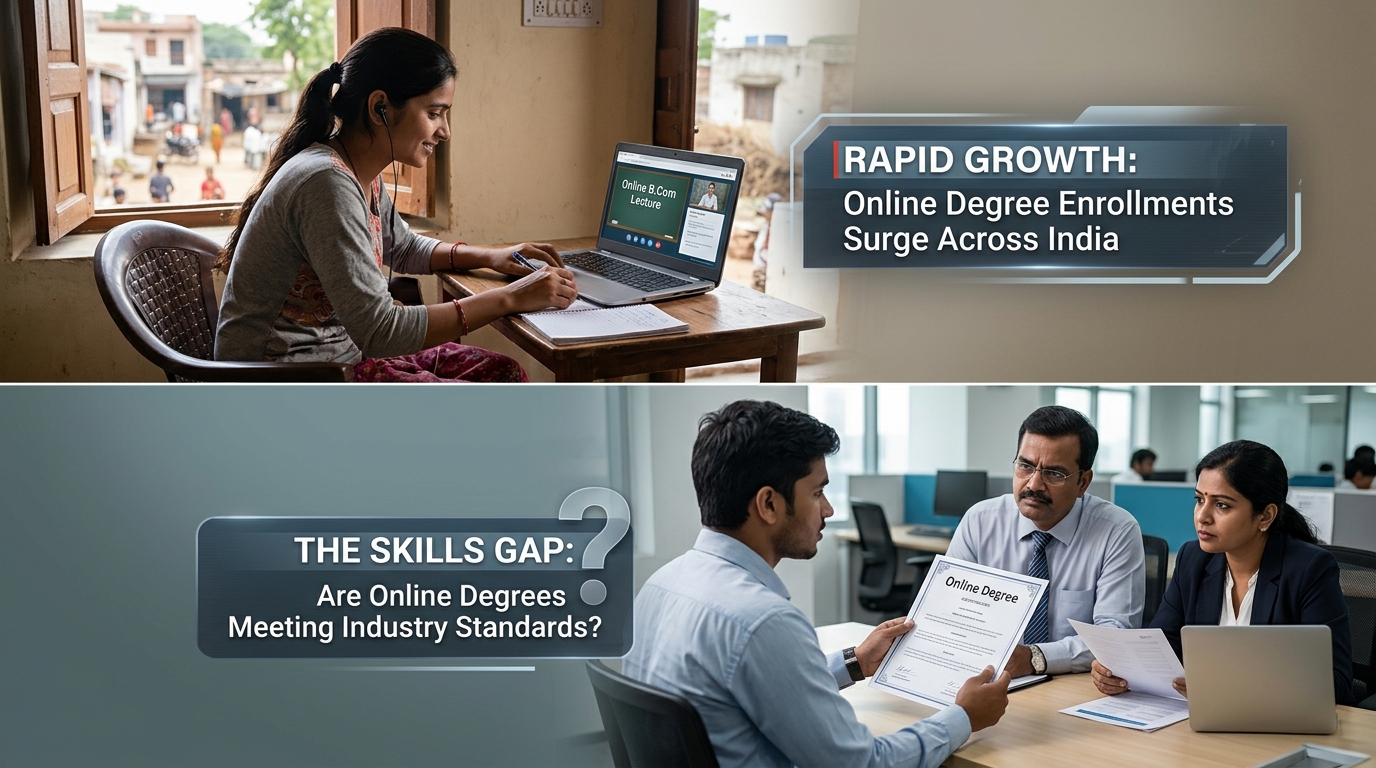
Online and distance education programmes are growing rapidly across India, driven by rising internet access, flexible learning models and increasing demand from working professionals and students outside major cities.
Universities have expanded online undergraduate and postgraduate courses in subjects ranging from management and commerce to computer applications and data science. Education analysts say the sector has seen significant growth since the Covid-19 pandemic accelerated the shift towards digital learning.
But as enrolment numbers increase, questions are also emerging about the quality of education, practical skill development and long-term employability of graduates.
Recruiters and career advisors say some students completing online degrees continue to face difficulties during placements because of limited exposure to practical training, internships and collaborative learning environments.
“Flexibility has made higher education accessible to more students,” said a Delhi-based higher education consultant. “However, employers still expect candidates to demonstrate real-world problem-solving abilities and technical skills.”
Regulatory concerns continue
The University Grants Commission (UGC), India’s higher education regulator, has repeatedly issued advisories asking students to verify whether universities and programmes are officially approved before taking admission.
The regulator recently invited fresh applications from institutions seeking permission to offer online and Open and Distance Learning (ODL) programmes for the 2026–27 academic session. Education experts say the move reflects growing demand, but also highlights the need for stricter quality oversight.
Courts have also examined issues related to higher education regulation in recent months. In one case, the Telangana High Court observed that distance education degrees obtained through unauthorised study centres outside university jurisdiction would not be considered valid.
Separate proceedings in the Delhi High Court linked to examination transparency and academic accountability have added to wider discussions around trust and quality standards in higher education systems.
Shift towards hybrid learning
Many universities are now attempting to address concerns by introducing hybrid learning models that combine online classes with practical workshops, industry projects and internship opportunities.
Institutions are increasingly investing in virtual labs, live mentoring sessions and skill-based certification programmes in areas such as Artificial Intelligence, Cyber Security and Business Analytics.
Industry experts say the future of online education in India may depend on whether universities can successfully combine accessibility with practical and employment-focused learning.
Higher education researchers believe online learning will continue to expand, particularly among working professionals and students in smaller towns, but say credibility will remain closely tied to teaching quality, industry exposure and regulatory compliance.