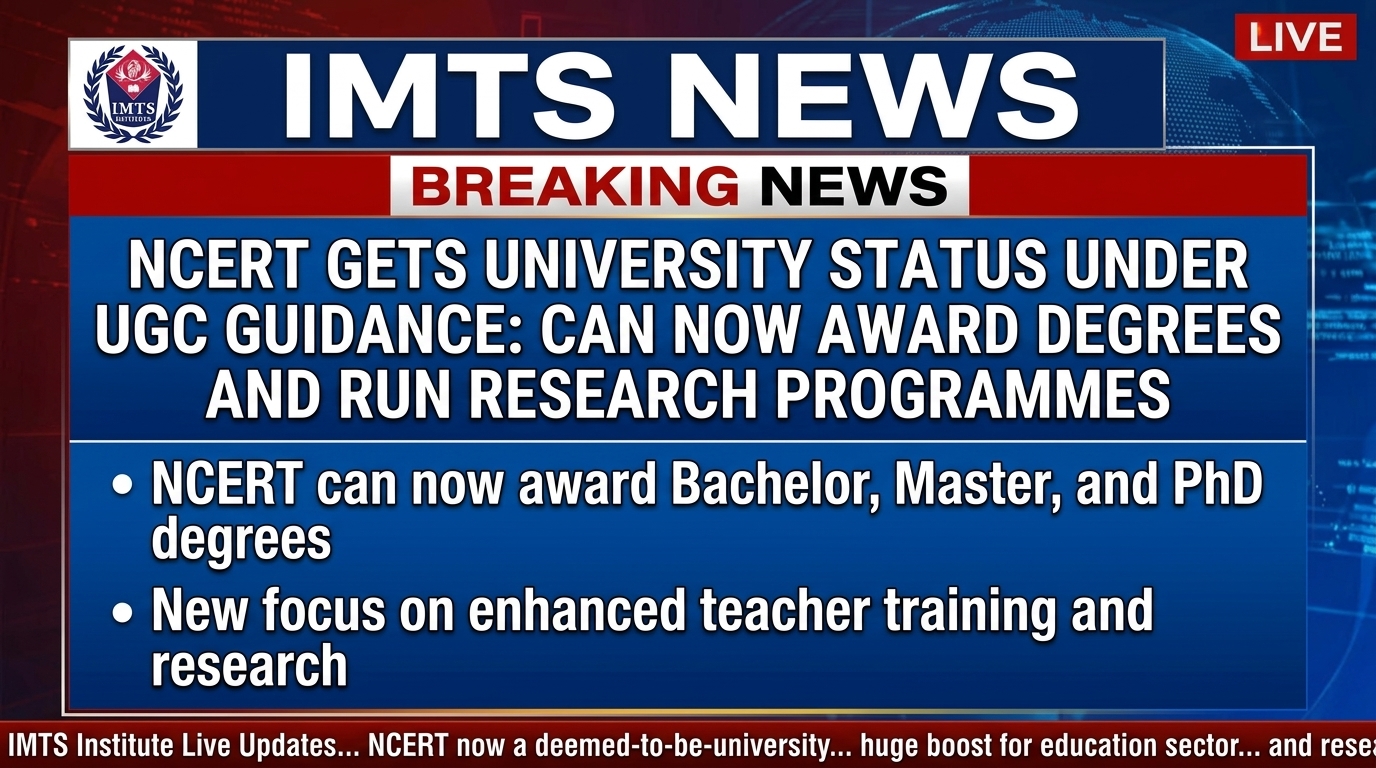
In a landmark development for Indian school education, the National Council of Educational Research and Training (NCERT) has been granted university status along with six of its constituent units under the guidance of the University Grants Commission (UGC). This makes NCERT one of the most significant institutional upgrades in Indian education policy in recent years.
NCERT, established in 1961, has been the backbone of India’s school curriculum — responsible for developing textbooks from Classes 1 to 12 used across all CBSE-affiliated schools and for providing advisory support to state governments on curriculum design. Until now, it functioned as an autonomous body under the Ministry of Education without the ability to grant academic degrees.

What University Status Means for NCERT
- NCERT can now offer independent degree, postgraduate, and doctoral programmes
- It can award PhD and other academic degrees without affiliation to another university
- It becomes eligible to participate in national and international academic rankings
- It can recruit researchers and faculty directly under UGC university norms
- Gains greater institutional autonomy in curriculum research and development
Why This Matters Under NEP 2020
NCERT is currently developing new textbooks aligned with the National Curriculum Framework for School Education 2023 (NCFSE 2023), which includes:
- Introduction of Artificial Intelligence and Computational Thinking for Classes 3 to 8
- Three-language framework from Class 6
- New Vocational Education and Art Education components
University status gives NCERT the academic credibility and institutional infrastructure to deepen this work with proper research backing, PhD scholars, and faculty with full university-level expertise. Education experts see this as a critical step toward making India’s NEP 2020 curriculum reform sustainable, credible, and research-driven rather than purely policy-driven.