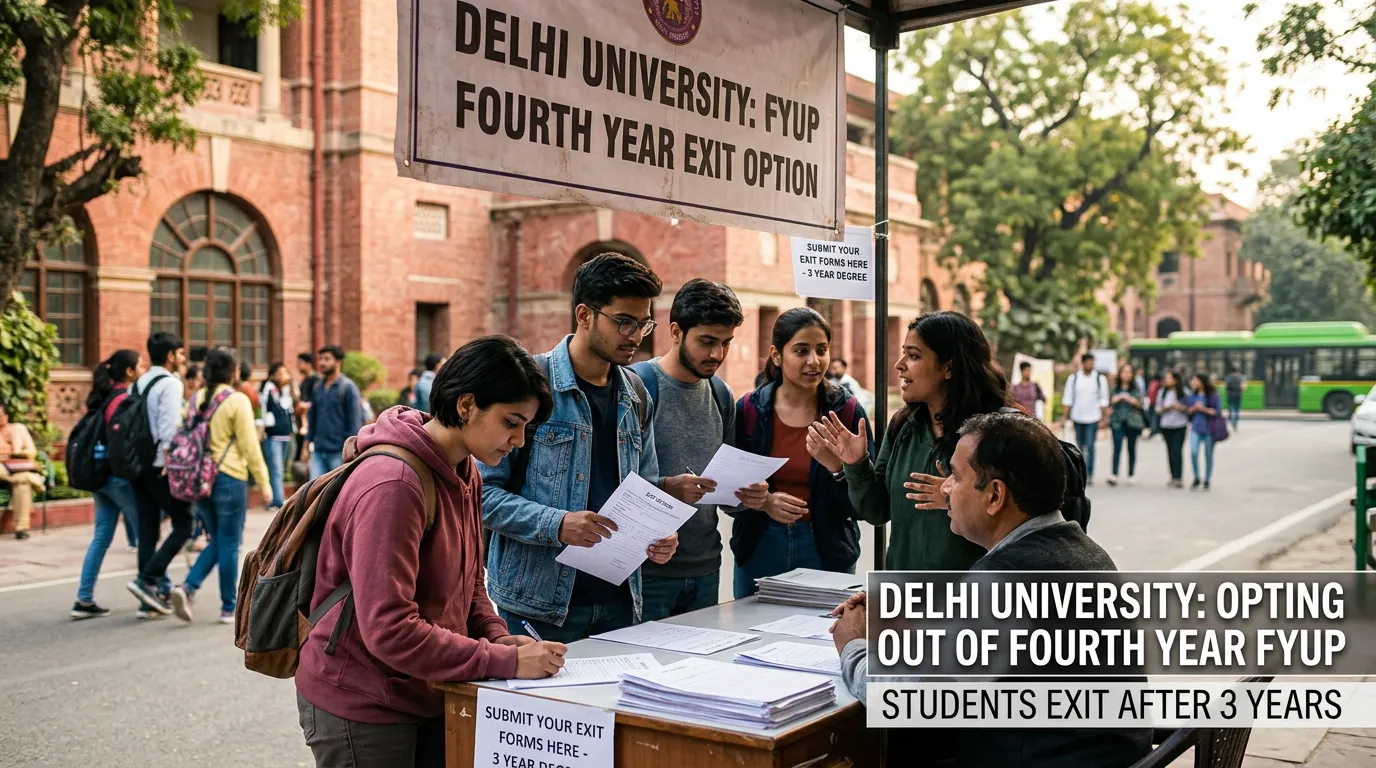
A significant number of Delhi University students are choosing to exit after three years rather than continue into the optional fourth year under the Four-Year Undergraduate Programme (FYUP). The DU FYUP Fourth Year 2026 rollout — the first full academic cycle of the fourth year under the National Education Policy (NEP) 2020 — has revealed a complex picture of student sentiment, institutional challenges, and policy concerns that are shaping one of Indian higher education’s most ambitious reforms.
The Numbers: How Many Students Are Opting Out?
The scale of the opt-out trend has sparked considerable debate. According to DU Vice-Chancellor Yogesh Singh, of approximately 66,000 third-year FYUP students eligible for the fourth year, around 30,014 students — nearly 45% — chose to exit with a conventional three-year bachelor’s degree rather than continue into the DU FYUP Fourth Year 2026. While the university administration has described the remaining 55% continuation rate as broadly encouraging and “as per expectations,” educationists and faculty unions have pointed out that nearly half of eligible students walking away from an optional academic year signals deeper structural concerns that cannot be dismissed.

What Is the FYUP, and What Does the Fourth Year Offer?
Introduced under NEP 2020, DU FYUP Fourth Year 2026 Programme offers students multiple exit points — a certificate after one year, a diploma after two, and a standard bachelor’s degree after three years. Students who complete the DU FYUP Fourth Year 2026 are awarded an Honours with Research degree, with the additional year focused on a research dissertation, entrepreneurship modules, and skill-based learning. DU Vice-Chancellor Yogesh Singh had earlier described this fourth year as a “game changer,” stating that it was the first time undergraduate education in Delhi University placed serious emphasis on research and entrepreneurial thinking.
Why Are Students Opting Out?
Despite the promise of a research-focused degree, the opt-out trend is driven by a combination of practical, academic, and structural concerns.
Competitive Exam Preparation: A large proportion of DU students use the third year as a springboard for high-stakes competitive examinations such as CAT, UPSC CSE, CLAT PG, and various state-level exams. For these students, spending an additional year on a research dissertation offers little immediate career advantage compared to beginning dedicated exam preparation.
Uncertainty Over PG Admissions: One of the most pressing concerns surrounding the DU FYUP Fourth Year 2026 is the lack of clarity over postgraduate admissions. Most Indian universities have not yet transitioned to one-year PG programmes designed to accommodate four-year UG graduates. With only a handful of universities — such as Lucknow University — claiming to have introduced one-year PG courses, students fear being left in an academic grey zone where their Honours with Research degree does not align cleanly with existing PG or PhD pathways.
Infrastructure and Faculty Shortages: Reports from multiple Delhi University colleges have painted a troubling picture of the fourth year’s on-ground reality. Students who opted for the DU FYUP Fourth Year 2026 have reported sudden rule changes, limited course options, and a visible shortage of qualified faculty to supervise research dissertations. The university has directed senior regular faculty to teach and guide fourth-year students and to appoint guest faculty as required — but many colleges have struggled to implement this at scale.
No Government Incentives: Neither the central government nor any state government has announced specific incentives — such as higher weightage in public sector recruitment or reserved PG seats — for students completing a four-year undergraduate degree. Without tangible policy benefits, many students have understandably questioned the return on the additional year of time and financial investment.
Discipline-wise Divide: Humanities vs. Commerce and Science
The DU FYUP Fourth Year 2026 data reveals a striking discipline-wise divergence in student choices. Humanities and language departments have reported the highest participation rates, with several programmes at colleges like Lady Shri Ram College recording 70–80% fourth-year retention in subjects like Psychology and English. In contrast, science and commerce departments have recorded considerably lower continuation numbers. At Shri Ram College of Commerce (SRCC), for instance, only around 170 of nearly 900 eligible students chose the fourth year — a reflection of the commerce stream’s strong orientation towards professional courses like CA, MBA, and financial certifications.
What the University Is Saying
The Delhi University administration has acknowledged that concerns about preparedness are genuine. Vice-Chancellor Yogesh Singh has assured that “facilities will be created” to support the DU FYUP Fourth Year 2026 initiative and that any issues arising during implementation will be resolved gradually. The university has also passed a resolution to introduce one-year PG programmes — though teachers’ associations have protested that the resolution was passed without adequate dialogue with faculty stakeholders.
The Road Ahead
The DU FYUP Fourth Year 2026 is ultimately a reflection of the larger tensions inherent in implementing a sweeping educational reform at scale. While the vision of producing research-oriented, entrepreneurially minded undergraduates is laudable, the gap between policy ambition and ground reality remains wide. For the FYUP’s fourth year to achieve genuine traction in the years ahead, Delhi University will need to urgently address faculty shortages, clarify PG pathways, and work with the government to create tangible incentives for students who choose to stay.