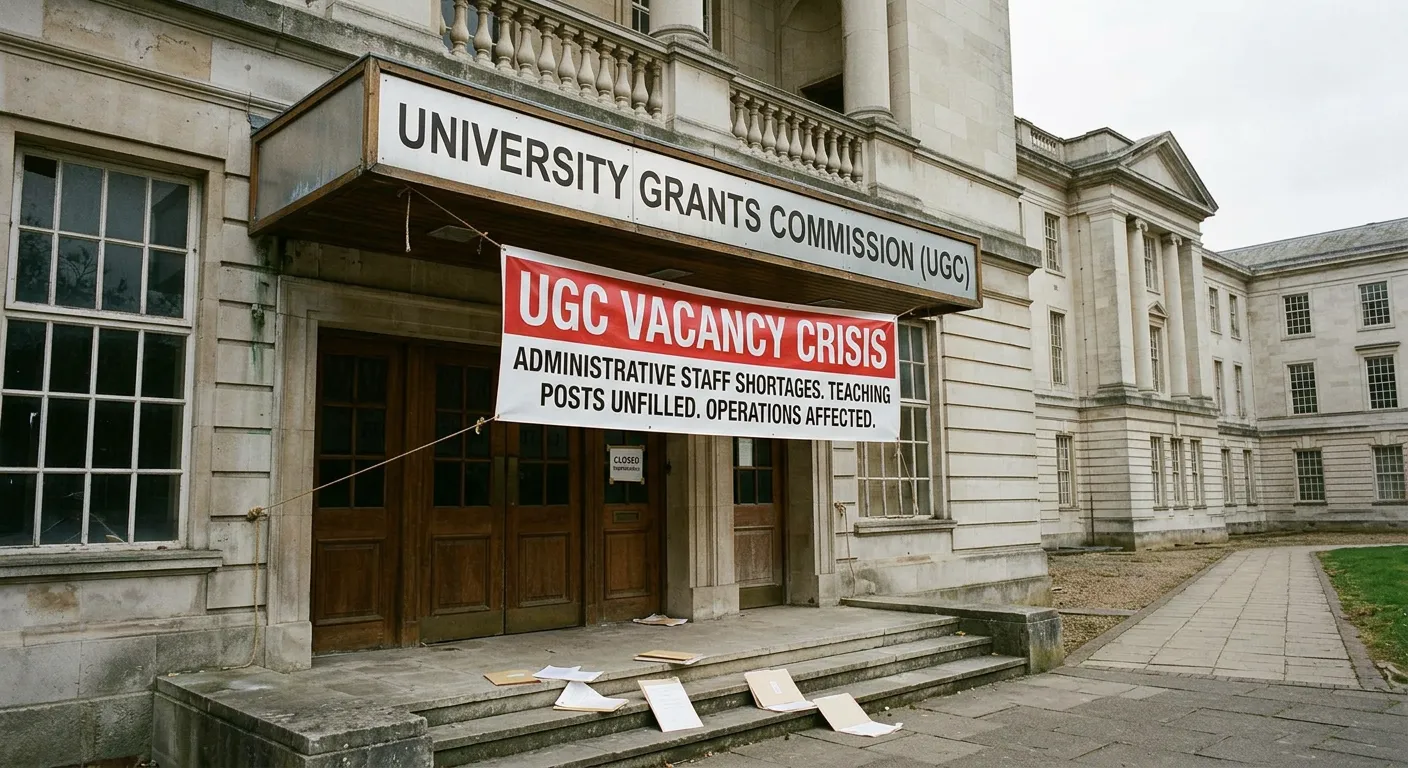
India’s higher education system is facing a deepening crisis that threatens the academic future of millions of students. The UGC Vacancy Crisis — a chronic and worsening shortage of permanent faculty across central universities, state universities, and deemed institutions — has persisted for years despite repeated directives from the University Grants Commission (UGC) and the Ministry of Education. Data from RTI filings, parliamentary disclosures, and state government admissions paint a troubling picture of a system where nearly one in three teaching posts sits empty, often for years at a stretch.
The Scale of the Problem
The numbers behind the UGC Vacancy Crisis are staggering. According to data disclosed by the Ministry of Education in Lok Sabha, as many as 5,825 teaching posts and 15,390 non-teaching posts were lying vacant across central universities alone as of April 1, 2023 — and independent data suggests the situation has worsened since. An RTI filed by Bihar-based social activist Kanhaiya Kumar and accessed by national media revealed that despite the UGC issuing directives at least seven times since 2019 asking institutions to fill vacant posts, nearly 27 percent of the 18,940 sanctioned teaching positions across India’s 46 central universities remain unfilled.

The reserved category dimension of the UGC Vacancy Crisis is even more alarming. Over 38 percent of teaching posts reserved for SC, ST, and OBC candidates remain vacant, according to the same RTI. For the Economically Weaker Sections (EWS) category — introduced in central universities five years ago — nearly 71 percent of reserved teaching posts are yet to be filled, exposing a deep and systemic failure in inclusive academic recruitment.
Which Universities Are the Worst Affected?
The UGC Vacancy Crisis is not evenly distributed. Some of India’s most prominent institutions lead the vacancy charts. Banaras Hindu University (BHU) tops the list with 576 vacant reserved-category posts, followed closely by Delhi University with 526 reserved vacancies. Universities of Allahabad, Visva Bharati, and Hemwati Nandan Bahuguna Garhwal University each report over 200 vacancies in reserved categories alone.
In Karnataka, the state’s Higher Education Minister admitted to the state legislature that over 9,000 posts — including nearly 3,000 teaching and 6,000 non-teaching positions — are vacant across state universities, with several institutions also lacking basic infrastructure and administrative resources. A Cabinet sub-committee headed by Deputy Chief Minister DK Shivakumar has been formed to review the situation, but critics argue such committees have been formed before without producing lasting solutions.
At the national level, India has over 9.83 lakh vacant sanctioned teacher posts across all levels of education, according to a comprehensive March 2026 analysis by education researchers. The UGC Vacancy Crisis at the higher education level is part of this far wider teacher supply failure that threatens India’s ability to meet its National Education Policy 2020 goals.
Why Are Posts Lying Vacant?
The causes driving the UGC Vacancy Crisis are complex and interlocking. The UGC Chairman has acknowledged that “faculty selection is often a complex and lengthy process,” requiring institutions to recruit teachers with specialised expertise who may not be readily available. However, civil society groups and faculty associations point to far more troubling explanations.
Five central universities — including JNU and the University of Hyderabad — have cited “none found suitable” as the reason for leaving hundreds of reserved-category posts unfilled over five consecutive years. Researchers and equity advocates argue that this reasoning masks systemic discrimination in selection committees, which often lack social diversity and may reject qualified SC, ST, and OBC candidates on subjective grounds.
Structural factors compound the problem further. The shift to a 13-point roster system, which treats individual departments as the unit of recruitment rather than the institution as a whole, drastically reduces the number of reserved seats available in any given recruitment cycle. Add to this the slow pace of administrative approvals, bureaucratic delays in finalising advertisement notifications, and the challenge of retaining qualified candidates who opt for better-paying private sector or industry roles — and the scale of the UGC Vacancy Crisis becomes easier to understand, if no less acceptable.
The Impact on Students and Education Quality
The fallout of the UGC Vacancy Crisis falls hardest on students. When permanent faculty positions go unfilled, universities substitute with ad-hoc and guest faculty — contractual arrangements that provide no job security and little incentive for long-term commitment to teaching and research. The result is high turnover, inconsistent academic mentorship, understaffed research programmes, and deteriorating quality of instruction, particularly in postgraduate and doctoral programmes.
This is especially damaging at a time when India’s higher education system is simultaneously trying to implement the ambitious Four-Year Undergraduate Programme under NEP 2020, expand research output, and improve its global university rankings. A system grappling with the UGC Vacancy Crisis cannot credibly pursue these goals without first addressing the foundational problem of who is doing the teaching.
What Needs to Happen
Resolving the UGC Vacancy Crisis requires more than periodic reminders from the UGC to universities. Experts and faculty associations have called for time-bound statutory mandates on vacancy filling, independent oversight of selection committee composition, reform of the roster system to ensure fair representation, and financial incentives to make academic careers more attractive to qualified candidates. Central universities, being autonomous bodies created under Acts of Parliament, cannot be directly compelled by the UGC — but the Ministry of Education has the authority and the obligation to act with greater urgency.
Until then, India’s classrooms will continue to run on half-strength — and students will continue to pay the price.