The rulebook of Indian hiring is being rewritten. For decades, the sequence was predictable: earn a degree, list it on your resume, and let its name carry weight in the hiring process. The degree was the primary filter. Everything else was secondary.
In 2026, that sequence is being disrupted — and students who do not understand the disruption risk investing in education that no longer delivers the career returns it once did.

What Skill-First Hiring Actually Means
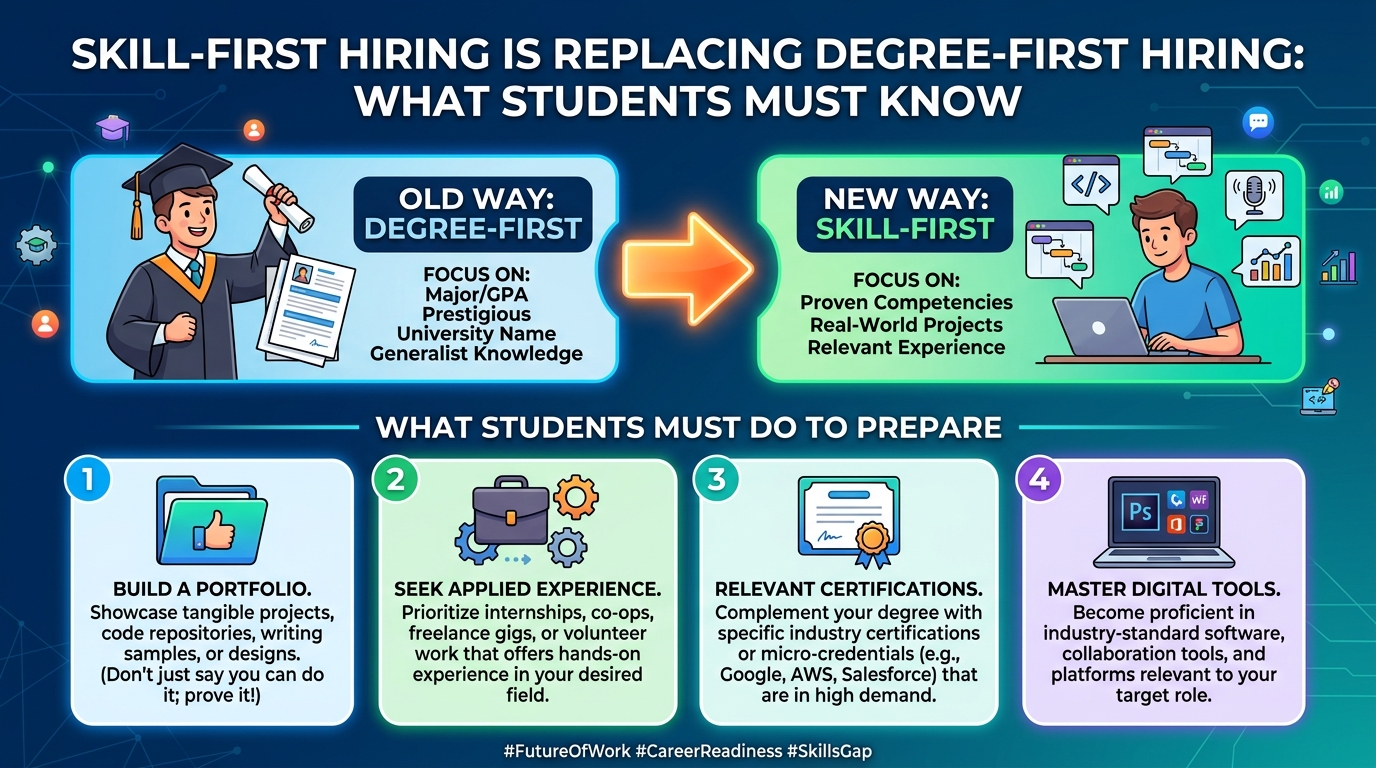
Skill-first hiring is a recruitment philosophy where employers evaluate candidates based on demonstrable capability rather than academic credentials alone. It does not mean degrees are irrelevant. It means degrees are no longer sufficient on their own.
Global technology companies — including Google, Microsoft, and IBM — began adopting skill-first frameworks several years ago, removing degree requirements from many roles. Indian companies are following at an accelerating pace. In sectors including IT, digital marketing, financial services, and logistics, recruiters are placing increasing weight on portfolio evidence, project work, assessments, and demonstrated problem-solving over grade transcripts.
Why the Shift Is Happening Now
Several forces are converging to accelerate skill-first hiring in India. The rapid proliferation of degree programmes — particularly online — has diluted the signal value of the credential itself. When everyone holds a degree, the degree alone no longer distinguishes.
Simultaneously, AI-era job roles require adaptive, applied competencies that theoretical education frequently does not develop. Employers have discovered through experience that hiring on credentials alone produces candidates who underperform on practical dimensions.
The Education Model Problem
Most traditional degree programmes — including many online offerings — are designed around content delivery and examination performance. Students consume material, memorise frameworks, and demonstrate retention through tests.
Skill-first hiring environments value something different: evidence of application. Can you use a framework under pressure? Have you solved a real problem? Have you worked in a team with actual stakes?
WILP programmes are structurally aligned with skill-first hiring because their assessment architecture is built around applied performance rather than theoretical recall. Students in WILP frameworks accumulate exactly the kind of documented applied experience that skill-first hiring processes are designed to surface.
Industry Demand Insights
A 2025 survey of 500 Indian employers across ten sectors found that over 60 percent weighted practical project experience equally or more heavily than academic scores when shortlisting candidates. In technology and management roles, the figure exceeded 70 percent.
Universities that have responded to this demand — building live project components, industry mentorship, and applied assessment models into their degrees — are producing graduates whose profiles align naturally with what skill-first hiring environments reward.
MIT University Sikkim’s focus on practical, industry-aware education reflects this understanding. The institution’s programme design recognises that in a skill-first hiring market, a degree’s value is determined not just by its name but by what it required the student to actually do.
What Students Must Do Differently
For students entering higher education today, the implication is clear. Choosing a programme based on convenience, name recognition, or fee alone is a narrowing strategy in a widening market.
Evaluate programmes based on their applied learning components, industry partnerships, mentorship quality, and employment outcomes. Ask universities: What live projects do students complete? Who mentors them? What percentage of graduates are employed in relevant roles within six months of graduation?
These questions — not rankings or marketing brochures — will help identify programmes that genuinely prepare graduates for a skill-first hiring world.