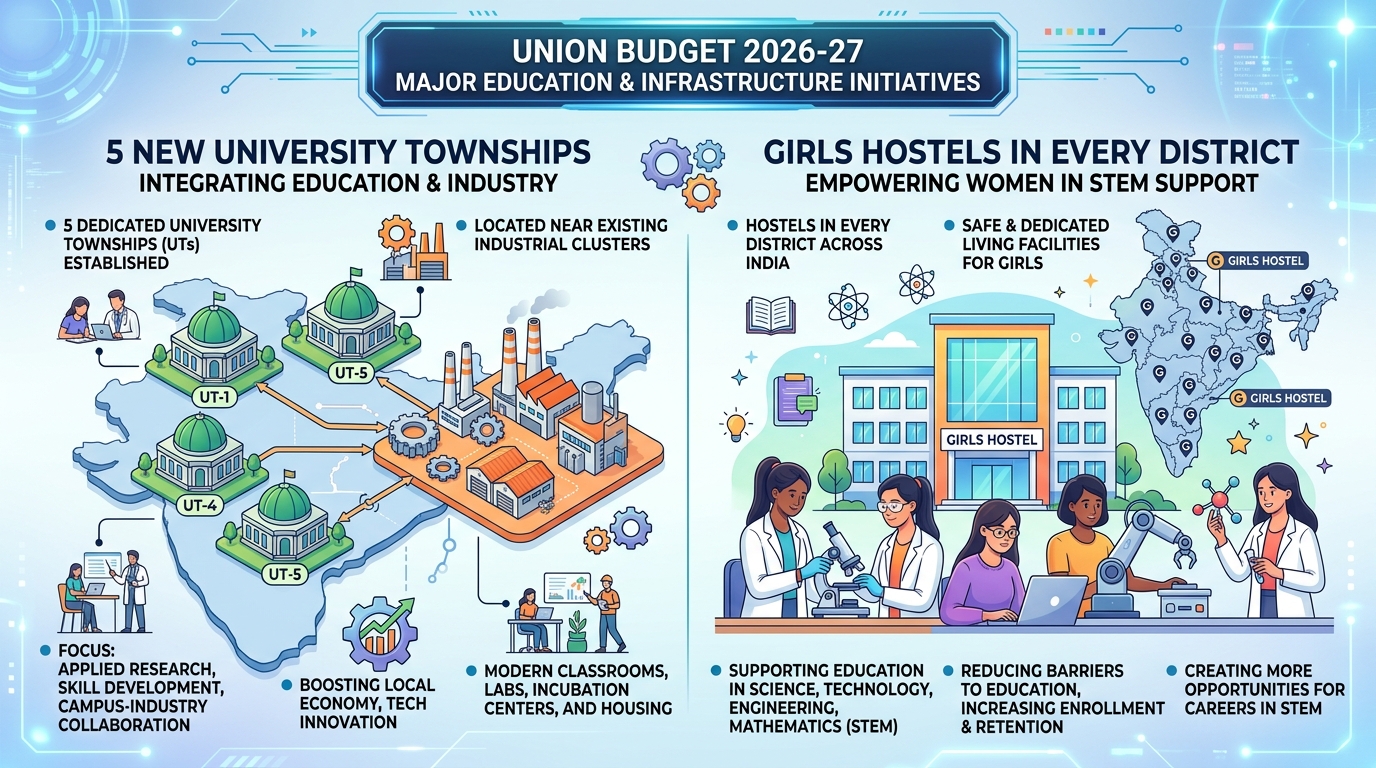
The Union Budget 2026-27 has announced a transformative infrastructure investment establishing five university townships in proximity to major industrial and logistics corridors across India. These planned academic complexes will integrate multiple universities, affiliated colleges, student residential facilities, and advanced research infrastructure, creating comprehensive educational ecosystems directly linked to employment opportunities and industry partnerships.
The budget allocation further mandates the establishment of dedicated girls hostels in every district, specifically supporting female students pursuing STEM (Science, Technology, Engineering, Mathematics) courses. This initiative directly addresses documented barriers preventing women’s participation in science and engineering disciplines, including extended laboratory hours, limited accommodation options in proximity to technical institutions, and socio-cultural constraints affecting women’s residential mobility.

These announcements align with the National Education Policy 2020 framework, which prioritizes gender-inclusive STEM education, industry-linked learning, and geographic equity in educational infrastructure access. The Ministry of Education website documented these developments on May 13, 2026, reflecting government implementation progress.
The university township initiative operates through a challenge method funding mechanism, inviting competitive bids from state governments and educational institutions to establish world-class academic infrastructure combining classroom teaching, research laboratories, faculty residential quarters, student amenities, and industry liaison offices. This integrated model promotes research commercialization, start-up incubation, and graduate employment pathways within operational university campuses.
BUDGET 2026-27 EDUCATION INITIATIVES:
University Townships: 5 Establishments near industrial centres Girls Hostel Mandate: Every district nationwide Implementation Mechanism: Challenge method competitive bidding Policy Framework: National Education Policy 2020 Primary Objective: STEM participation equity and industry linkage Official Documentation: Ministry of Education portal
SYSTEMIC IMPACT ON WOMEN IN STEM:
Historically, women comprise only 20-25 percent of engineering students and less than 15 percent of computer science enrollments in India. Accommodation barriers, combined with demanding laboratory schedules and sociocultural factors, contribute significantly to women’s underrepresentation. The district-level girls hostel scheme removes critical infrastructure barriers, while university townships near industrial zones improve employment visibility and post-graduation opportunities for women graduating from STEM programs.
Female students in smaller cities and semi-urban regions benefit disproportionately, as they previously lacked quality technical institutions within commutable distance. The township model, embedding universities within industrial zones, provides internship accessibility, apprenticeship placements, and direct employer interaction during academic years, significantly improving graduate employment outcomes and entrepreneurial confidence.