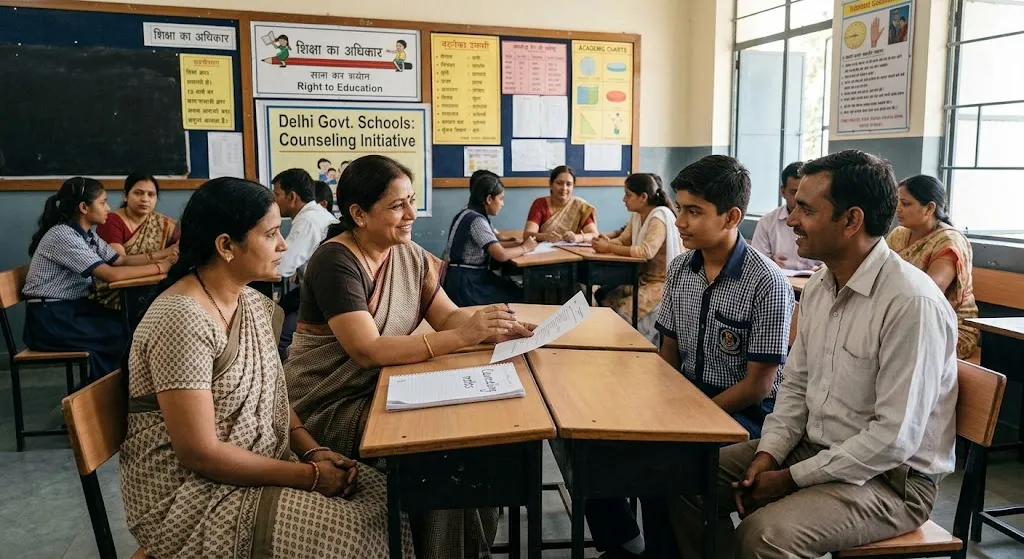
In a significant move to address the growing concern of Class 9 failures in Delhi government schools, the Directorate of Education (DoE) has directed school heads to actively counsel students who have failed Class 9 more than once — along with their parents — to prevent them from dropping out of the mainstream education system. The initiative underscores a broader acknowledgment that academic failure at this critical juncture can permanently derail a student’s future if left unaddressed.
The Scale of the Problem
The numbers paint a sobering picture. According to data shared by the Ministry of Education in the Rajya Sabha, Class 9 failures in Delhi government schools were more than 3.20 lakh over five years. The figures climbed steadily — from 31,541 failures in 2020–21 and 28,548 in 2021–22, they surged dramatically to 88,421 in 2022–23 and peaked at a staggering 1,01,344 in 2023–24, before partially receding to 70,296 in 2024–25. In the academic session 2023–24 alone, 17,308 students failed Class 9 for the second consecutive time, highlighting just how acute the problem has become.

What the Directive Says
As per the DoE circular, heads of government schools are now mandated to counsel Class 9 failures in Delhi government schools, students who have failed Class 9 twice, as well as their parents, emphasising the critical importance of continuing education. The initiative also involves enrolling such students in the National Institute of Open Schooling (NIOS), which allows learners to study at their own pace and choose subjects that align with their interests. Upon completing Class 10 through NIOS, students can return to their parent schools and re-enter the formal education stream.
The directive has received the prior approval of the competent authority, signalling institutional commitment at the highest level of the Directorate of Education regarding Class 9 failures in Delhi government schools.
NIOS as a Safety Net
Class 9 failures in Delhi government schools: Of the 3.20 lakh students over five years, approximately 71,124 were admitted to NIOS — representing about 22 per cent of total failures. While some view this as a meaningful intervention, critics argue it risks quietly pushing students out of the mainstream. The highest NIOS intake was recorded in 2022–23, when 29,436 students enrolled, suggesting that in years of peak failure, the open schooling route becomes a vital lifeline.
Proponents, including the central government, maintain that NIOS is not a dead end but a bridge — one that keeps students engaged with education and offers a credible path back to formal schooling.
The Larger Question
The counselling directive arrives amid a politically charged debate over the quality of education in Delhi’s government schools. Regardless of political attribution, what remains beyond dispute is that repeated Class 9 failures in Delhi government schools represent a systemic challenge requiring urgent, sustained action — not just policy directives, but improved classroom support, teacher training, and mental health resources for students under academic stress.
Counselling students and their families is a compassionate first step. But ensuring that fewer students reach the point of repeated failure in the first place must be the ultimate goal.
The decision follows observations that many students are experiencing Class 9 failures in Delhi government schools. struggle with motivation and lack adequate support. Education authorities have emphasized that the objective is not merely to improve pass percentages but to ensure that every child remains connected to the education system.
Under the NIOS project, students can choose subjects according to their interests and later return to mainstream schooling after completing Class 10. The government hopes that this approach will reduce dropout rates and provide a second chance to students affected by repeated
The latest directive reflects the Delhi government’s broader strategy to strengthen student retention and provide inclusive opportunities for learners who face difficulties in conventional schooling.
For further information, students can also check the official website of the Delhi Directorate of Education.