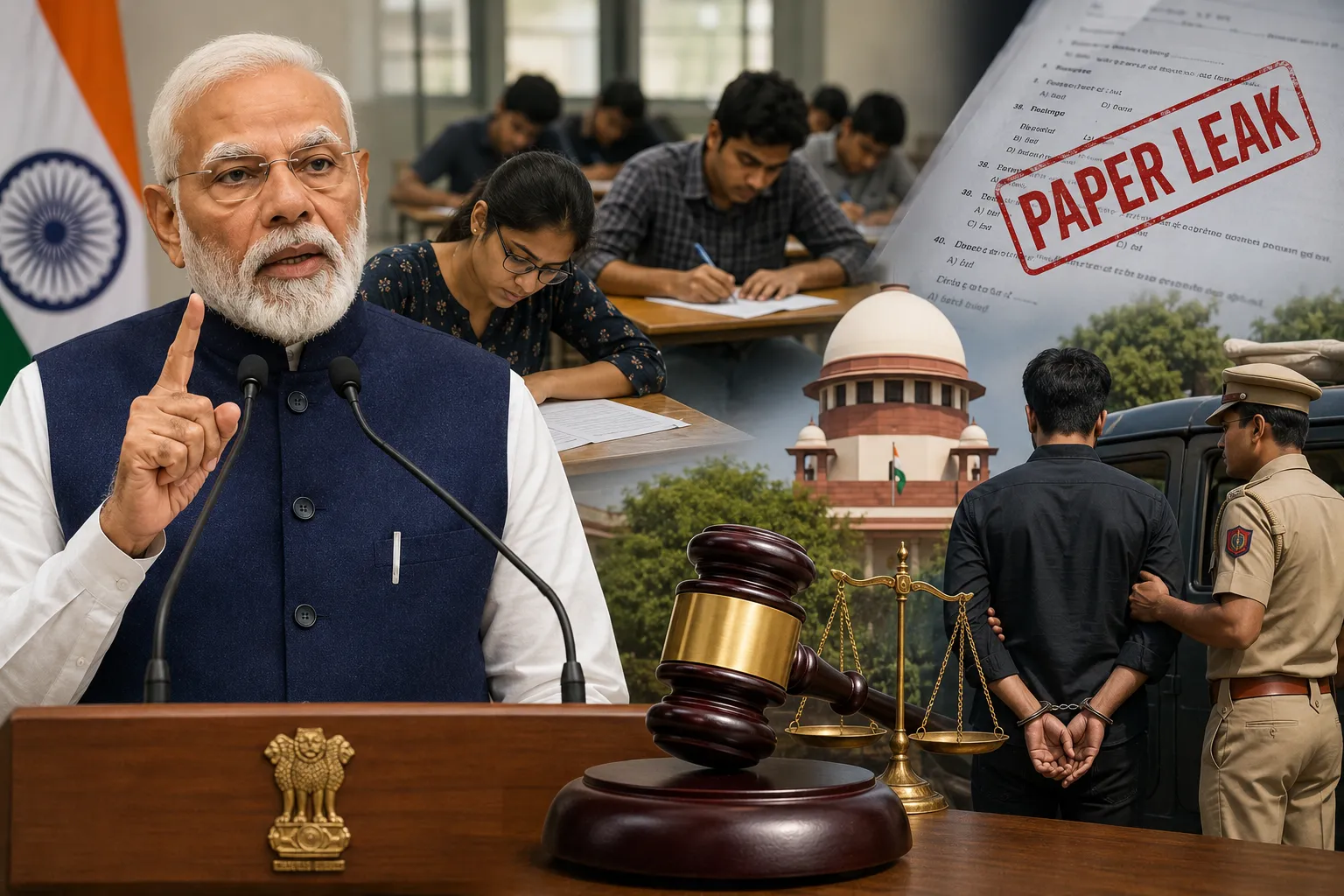
PM Modi fast-track: Prime Minister Narendra Modi announced on 23 July 2026 that the government will set up fast-track courts to ensure swift and stringent punishment for those involved in examination paper leaks. In a post on X, PM Modi said that “those who try to harm the future of our youth will not be spared,” adding that he has directed concerned authorities and officials to take all necessary steps in this regard. The PM Modi fast-track courts announcement comes at a time when student protests over alleged examination irregularities have intensified across the country.
PM Modi Fast-Track Courts: What Was Said
Describing the welfare and future of the country’s youth as the government’s top priority, PM Modi stated that the new fast-track courts would help ensure speedy trials and stringent punishment for those found guilty in paper leak cases. He said the PM Modi fast-track courts initiative continues a series of steps taken by the Central government to safeguard the interests of students and restore confidence in the examination system. The Prime Minister added that instructions have already been issued to the concerned departments to ensure all necessary action is taken without delay.

Background: Protests Over Alleged Exam Irregularities
The announcement comes amid ongoing student-led protests in Delhi, where demonstrators have been demanding accountability over alleged irregularities linked to this year’s NEET-UG examination. The protests, which began as a small campaign in mid-May, have since grown into a larger movement, with activists camping at Jantar Mantar for over a month. An indefinite fast by a well-known education and climate activist, along with other students, has further drawn national attention to the demonstrations. Tensions escalated earlier this week when protesters attempting to march towards Parliament clashed with police.
Legal Framework Behind the Move
India already has the Public Examinations (Prevention of Unfair Means) Act, 2024, which criminalises question paper leaks and other organised malpractice in public examinations. Under this law, individuals found guilty of resorting to unfair means can face imprisonment ranging from three to five years along with a fine of up to Rs 10 lakh. Those involved in organised crimes linked to paper leaks may face a jail term of five to ten years and a fine of at least Rs 1 crore. The proposed fast-track courts are expected to work within this existing legal framework to speed up the resolution of pending and future cases.
What This Means for Students Going Forward
For lakhs of aspirants preparing for competitive and entrance examinations, the announcement signals a renewed push to strengthen accountability in the examination system. Once operational, the PM Modi fast-track courts are expected to reduce the time taken for trial and conviction in paper leak matters, which have historically dragged on for years. Students and parent groups are likely to watch closely for further details on how and when these courts will be constituted, as well as which pending cases will be taken up first under the new mechanism.
Also Read….