In a significant development for hundreds of displaced families, the Delhi High Court has stepped in to ensure that no child’s education is disrupted during the Savda Ghevra rehabilitation of slum dwellers from clusters near the Prime Minister’s residence. The Delhi High Court has directed authorities to strictly implement all commitments made regarding the rehabilitation of jhuggi-jhopri (JJ) dwellers proposed to be relocated to Savda Ghevra, while emphasising that rehabilitation must be carried out in a manner that safeguards the residents’ right to live with dignity.
Court Directs Admission in Nearby MCD and Government Schools

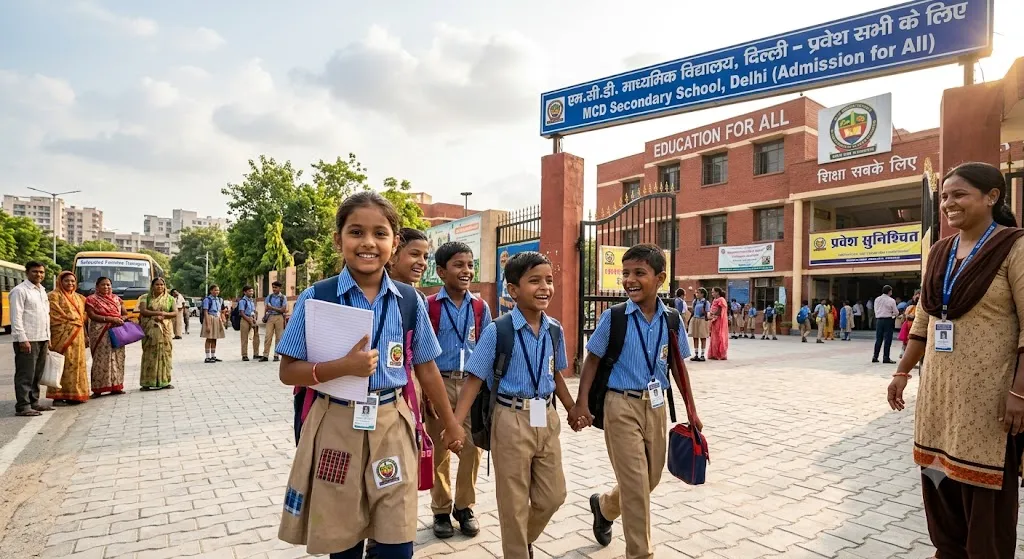
Addressing one of the biggest concerns raised by families ahead of the Savda Ghevra rehabilitation, the court issued a clear directive. The Court directed that children of relocated families be granted admission in nearby government and MCD schools, and that officials posted at the camp office assist families in securing admissions. This direction was made binding upon both the Municipal Corporation of Delhi and the Education Department of the Government of NCT of Delhi.
Background of the Case
A Division Bench comprising Chief Justice Devendra Kumar Upadhyaya and Justice Tejas Karia passed the interim directions while hearing appeals filed by Rakesh Bansal and others and Khushnuma Khan and others, challenging a judgment of a Single Judge dated May 11, 2026. The appellants were represented by Senior Advocate N Hariharan along with a team of advocates.
The case stems from the planned relocation of 717 families from slum clusters near Lok Kalyan Marg, the road housing the Prime Minister’s official residence. The site chosen for the Savda Ghevra rehabilitation lies on the outskirts of Delhi near the Tikri border, and residents had earlier raised concerns about the lack of basic infrastructure there.
School Capacity Information Submitted to Court
To address these concerns, detailed data on educational facilities were placed before the bench. Information regarding government and MCD schools in and around the area, including teacher strength and admission capacity, was placed before the Bench. The affidavits also confirmed that electricity connections, street lighting, water supply infrastructure, underground reservoirs, sewerage systems, roads, parks and security arrangements are available at the site, while details regarding nearby healthcare facilities, including dispensaries and Sanjay Gandhi Government Hospital, were also furnished.
Additional Amenities Promised to Relocated Families
Beyond education, the court also secured commitments on essential household amenities as part of the Savda Ghevra rehabilitation package. During the hearing, the respondents undertook to provide one ceiling fan and one induction cooker to each relocated family, and DUSIB assured the Court that assistance would be provided for securing LPG connections at the earliest.
Housing Allotment Status for Affected Families
On the housing front, significant progress has already been made. The government assured that all 717 affected families would receive housing units, with 248 already accepting allotments. The Court also recorded submissions that the Government had decided to bear the beneficiary contribution otherwise payable under the rehabilitation policy, and that all affected JJ dwellers, irrespective of questions regarding eligibility, would be provided housing units as part of the rehabilitation exercise.
Why the Relocation Is Happening
The Union Government, the Land and Development Office (L&DO), and the Delhi Urban Shelter Improvement Board (DUSIB) submitted that the land presently occupied by the dwellers is required for security considerations and the development of defence infrastructure. The authorities assured the Court that adequate arrangements were being made to ensure meaningful rehabilitation of the affected families.
Court Warns Against Non-Compliance
The bench made clear that these commitments are not optional. Stressing that rehabilitation must be implemented in a manner consistent with the right to rehabilitation and the right to live with dignity, the Court warned that any non-compliance with its directions would be dealt with seriously.
A History of Educational Disruption in Past Relocations
This is not the first time such concerns have been raised in Delhi. Past relocation exercises have often left children without access to schools for extended periods, with civic bodies failing to set up educational institutions in resettlement colonies in time — a pattern the court appears determined to avoid repeating during this Savda Ghevra rehabilitation.
Next Steps
The matter has been listed for further hearing on July 1, 2026, when the court will review compliance with its directions, including the status of school admissions, housing allotments, and the provision of basic amenities at Savda Ghevra. Affected families and advocacy groups will be closely watching whether these commitments translate into action on the ground before the next hearing date.